Updated November 2026
The strongest beer ever claimed is Snake Venom from Brewmeister in Scotland, sold at 67.5% alcohol by volume (ABV). That figure came from freeze distillation, not fermentation alone, and the UK Advertising Standards Authority ruled in 2014 that the brewery’s marketing of it was misleading. The strongest beer reached largely through fermentation and blending is Samuel Adams Utopias, whose 2025 release is 30% ABV.
The answer depends on what you count as beer. Below we separate freeze-concentrated record holders from fermented heavyweights. For basics on styles and strength, see our Beer Guide.
The short list of record claims
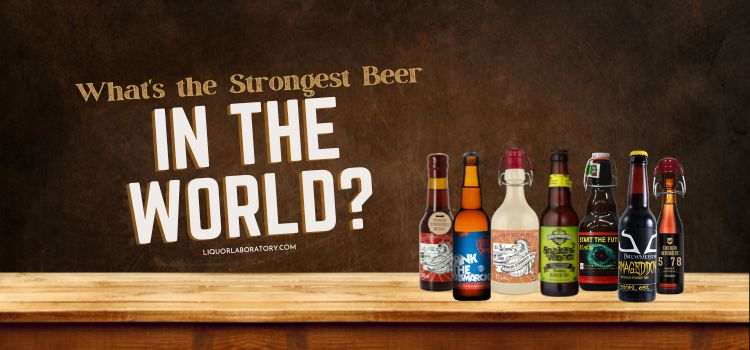
These are the beers documented during the “strongest beer” race of 2009 to 2020, with ABV as each brewery announced it.
- Brewmeister Snake Venom (Scotland): 67.5%. Freeze distilled, brewed with smoked peated malt and both beer and champagne yeasts, according to Brewbound. Released in 2013 to replace Armageddon.
- Brewmeister Armageddon (Scotland): claimed 65%. Brewmeister later acknowledged that some batches had been made at 15.2% ABV, a long way from the label claim.
- ‘t Koelschip Start the Future (Netherlands): 60%. Announced in 2010 by the Almere brewery. Its method was never clearly published, and a rival brewer publicly disputed the figure.
- BrewDog and Schorschbräu Strength in Numbers (Scotland and Germany): about 57.8%. A 2020 collaboration between the two former rivals, repeatedly ice distilled.
- Schorschbräu Schorschbock 57 (Germany): 57%. The German brewery’s answer to BrewDog’s 2010 release.
- BrewDog The End of History (Scotland): 55%. Some reports list 53%. Only 12 bottles were made, each presented inside a taxidermied animal.
- Schorschbräu Schorschbock 43 (Germany): 43%.
- BrewDog Sink the Bismarck! (Scotland): 41%. A freeze-concentrated IPA.
- De Struise Brouwers Black Damnation VI “Messy” (Belgium): 39%. An imperial stout freeze concentrated twice.
- BrewDog Tactical Nuclear Penguin (Scotland): 32%. The 2009 release that started the race.
- Samuel Adams Utopias (United States): 30% in the 2025 release. Earlier releases were about 28%. Fermented, barrel aged and blended rather than freeze concentrated.
Most of these were tiny one-off releases, so few are still on shelves.
Why normal beer stops around 12% to 15%
Yeast makes alcohol by eating sugar, but alcohol is toxic to yeast. As the ABV climbs, ordinary brewing strains slow down and then quit. Most beer yeasts tap out somewhere in the low teens, which is why even big imperial stouts and barleywines usually sit between 10% and 14%. Champagne yeast tolerates more, so extreme brewers often add it late. Nearly every record beer starts from a dark, malty base (see stout vs lager), and concentration also amplifies bitterness (see what IBU means in beer).
Samuel Adams says it gets Utopias to 30% with “a blend of proprietary yeasts that can withstand the conditions,” followed by aging of up to 30 years in barrels that have held Irish whiskey, Amarone and white Port, then blending with earlier vintages. Boston Beer describes the result as ruby-black and non-carbonated, with “layered flavors of caramel, oak, dried fruit, smoke, and subtle citrus,” and suggests one-ounce pours at room temperature. In other words, it drinks more like a fortified wine than a lager.
How freeze distillation pushes beer past 30%
Water freezes at a higher temperature than alcohol. Chill a finished beer until ice forms, lift out the ice, and what remains is stronger. Repeat it and the strength keeps rising. German brewers have used this idea for generations in the eisbock, a lager style made by freezing a strong bock and removing some of the ice, which typically lands near 9% to 14%.
The record chasers took the same process much further. Tactical Nuclear Penguin, Sink the Bismarck!, End of History, the Schorschbock series, Black Damnation VI and Strength in Numbers all relied on repeated freezing. Trade coverage of Strength in Numbers notes that products above roughly 60% can only be reached by distillation or by adding ethanol, at which point many people no longer consider them beer at all.
That is the heart of the Snake Venom controversy. In its 24 September 2014 ruling, the UK Advertising Standards Authority accepted that Brewmeister held a lab certificate showing 67.5% alcohol but found the ads misleading because they did not make clear that the strength came from freeze distillation and possibly from added ethyl alcohol. The ASA ordered that the ad not appear again in that form.
What a US beer label has to tell you
In the United States, the alcohol statement on a malt beverage follows 27 CFR § 7.65. Federal rules let brewers state alcohol content as a percentage by volume, and when they do, the label figure must be accurate within 0.3 percentage points either way for beers at or above 0.5% ABV. Terms such as “low alcohol” are limited to beer under 2.5% ABV. Separately, 27 CFR § 25.15 limits how much of a beer’s alcohol can come from added flavors: for products over 6% ABV, no more than 1.5% of the finished volume may come from alcohol in flavors.
Strength also triggers state rules. Utopias is not sold in 15 states, which Boston Beer lists as Alabama, Arkansas, Georgia, Idaho, Missouri, Mississippi, Montana, New Hampshire, North Carolina, Oklahoma, Oregon, South Carolina, Utah, Vermont and West Virginia, largely because those states cap the ABV of anything sold as beer.
How these beers compare with wine and spirits
A typical American lager is about 4% to 5% ABV. Most table wine is 12% to 14%, and Champagne usually sits near 12% (see how much alcohol is in Champagne). Standard vodka, whiskey and gin are bottled at 40% ABV, or 80 proof. That puts Tactical Nuclear Penguin at spirit-adjacent strength and Snake Venom well above most whiskey.
The US standard drink is 14 grams of pure alcohol, the amount in 12 ounces of 5% beer, 5 ounces of 12% wine, or 1.5 ounces of 40% spirit. At 30%, a 2-ounce pour of Utopias holds 0.6 ounces of alcohol, exactly the same as one standard drink (12 x 0.05 = 0.6). At 67.5%, a 1-ounce pour of Snake Venom holds about 0.68 ounces, slightly more than one standard drink. These are sipping products measured in ounces. For ordinary beers, see how many beers it takes to feel the effects, and never drive after drinking.
FAQ
What is the strongest beer in the world right now?
By claimed ABV, Brewmeister Snake Venom at 67.5% still holds the title, though it was freeze distilled and its marketing was ruled misleading in the UK. Among beers made by fermentation, barrel aging and blending, Samuel Adams Utopias 2025 at 30% is the strongest widely reported release.
Is a 67.5% beer really beer?
It started as beer, but freeze distillation and possible added alcohol make it closer to a spirit in strength. Many brewers and regulators treat anything near 60% or above as no longer beer in the usual sense.
What is the strongest beer you can buy in the US?
Samuel Adams Utopias is the best-known high-ABV beer sold in the US, except in the 15 states that restrict it. Availability changes with each release.
What is an eisbock?
A traditional German lager made by freezing a strong bock and removing some of the ice. It is the original version of the record chasers’ technique.
Sources
- Boston Beer Company, “Samuel Adams Releases Utopias 2025,” October 2025.
- Advertising Standards Authority (UK), ruling on Brewmeister Ltd, complaint A14-270227, 24 September 2014.
- Brewbound, “Brewmeister Releases Snake Venom, World’s Strongest Beer at 67.5 Percent.”
- Wikipedia, “Brewmeister Brewery” (Armageddon batches at 15.2% ABV; 2014 ASA censure).
- The Drinks Business, “The world’s 10 strongest beers,” October 2012.
- Inside.beer, “UK/Germany: Fight for the world’s strongest beer settled,” 2020.
- Brookston Beer Bulletin, “New Leader Emerges in Battle of Strongest Beer,” 2010.
- The Boston Globe, “Samuel Adams’ Utopias beer is banned in 15 states. Here’s why,” September 2021.
- Electronic Code of Federal Regulations: 27 CFR § 7.65 (alcohol content) and 27 CFR § 25.15 (flavors in beer).
- NIAAA, “What Is a Standard Drink?”