
Updated May 2026.
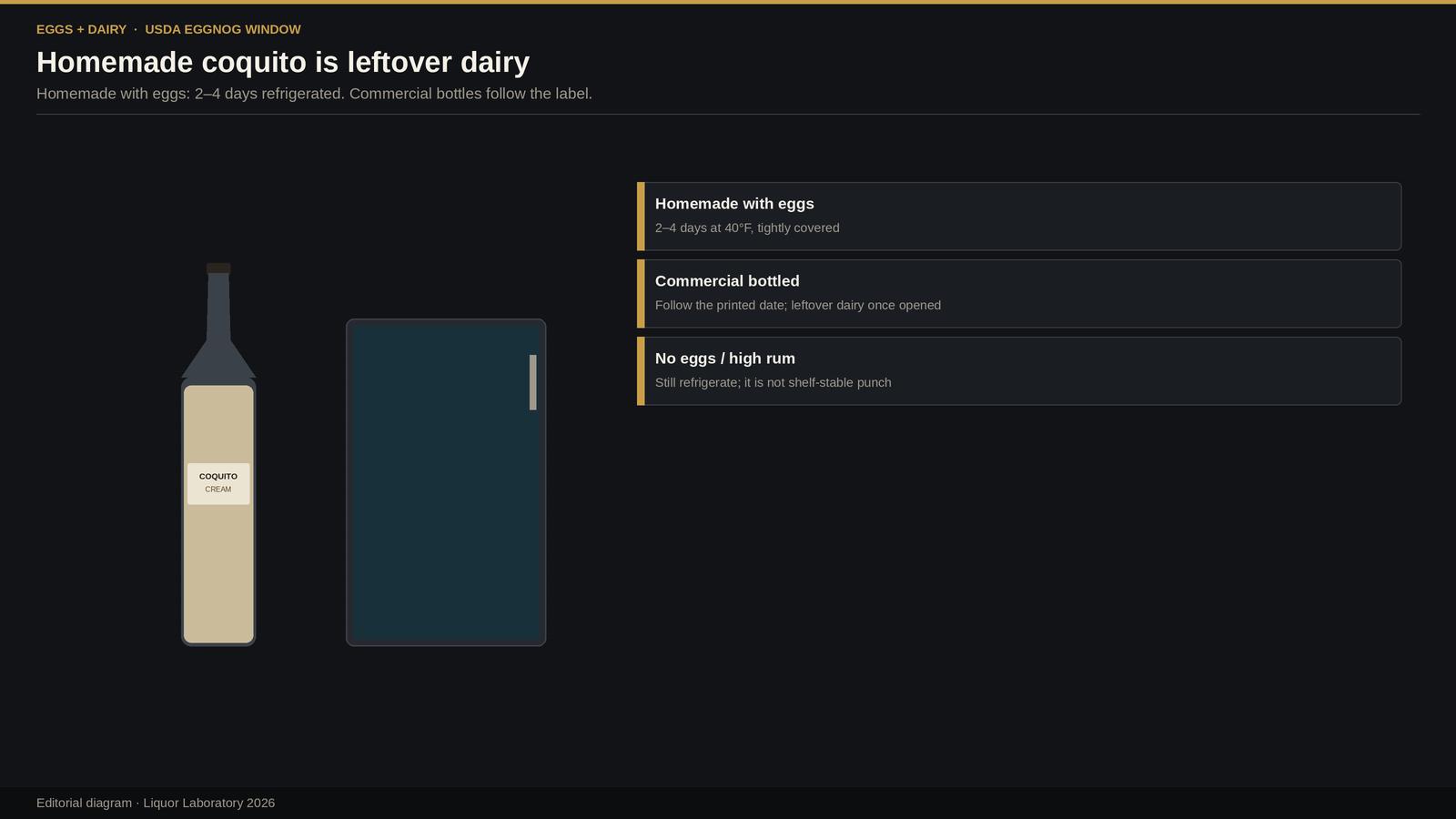
Homemade coquito is leftover dairy, even with rum. Treat an egg batch like homemade eggnog: 2 to 4 days in the fridge at 40°F. A USDA food-safety specialist told the Miami Herald the same four-day line for coquito because of the milk — eggs or not. Commercial bottled coquito follows its label. The leftover 2-hour rule still applies at a party.
Fridge and freezer windows
| Batch | Refrigerator (40°F or below) | Freezer | Authority |
|---|---|---|---|
| Homemade, with eggs (raw or cooked yolks) | 2–4 days | FSIS: do not freeze homemade eggnog | FSIS Shell Eggs chart, homemade eggnog row |
| Homemade, no eggs, dairy + coconut + rum | Still a few days. USDA’s Maribel Alonso put coquito — milk is the culprit — at four days, eggs or not | Not a USDA chart item; texture splits | Miami Herald interview with USDA specialist; not a 4–6 month pass |
| Commercial bottled coquito, unopened | Follow the printed date; refrigerate after opening if the label says so | Only if the label allows | Manufacturer, not folklore |
| Commercial, opened | 3–5 days is the commercial-eggnog analog; many labels are shorter | FSIS commercial eggnog: up to 6 months frozen | When the product is truly an eggnog-style dairy drink |
| Any coquito left out at a party | Discard after 2 hours at room temp (1 hour if above 90°F) | — | USDA leftover 2-hour rule |
Coquito is a coconut holiday punch — typically white rum, coconut milk or cream of coconut, sweetened condensed milk, evaporated milk, cinnamon, and sometimes egg yolk. It is not shelf-stable just because it is alcoholic. The old claim that eggless coquito lasts four to six months in the fridge is a recipe-blog number (The Noshery prints it). USDA leftover guidance does not support it, and this refresh will not repeat it as advice.
Rum is not a free pass
A punch that is mostly condensed milk with a cup of rum is not 40% ABV. Even a rum-forward coquito is usually in liqueur territory, not sanitizer territory. Alonso’s point in that Miami Herald piece: as soon as the evaporated or condensed milk can is open, the clock starts. Cooking yolks to 160°F (FSIS’s egg-dish line; Tia Clara’s traditional recipe holds ~165°F) lowers Salmonella risk. It does not earn months of storage. People in USDA’s at-risk groups — young children, adults older than 65, pregnant people, weakened immune systems — should not drink raw-egg holiday punch.
Store-bought coquito and cream liqueurs can be pasteurized and bottled for a longer unopened life. Read that bottle. For a commercial bourbon eggnog analog, see how long Evan Williams Egg Nog lasts.
Signs it is done
- Sour or yeasty smell that is not cinnamon and rum.
- Curds, lumps, or a pink or green tint.
- Fizz you did not put there.
- A lid that hisses or bulges.
When in doubt, throw it out. Holiday nostalgia is not a food-safety argument.
How to store a batch you made tonight
- Cool it quickly. Do not leave a warm pot on the counter overnight.
- Use a clean glass bottle or jar with a tight lid.
- Refrigerate immediately. 40°F or below.
- Label the date. Plan to finish egg batches in 2–4 days, and treat no-egg dairy batches as the same week — not the same season.
- Stir before serving; coconut fat can cap. Separation is normal. Spoilage is not.
- Do not ladle from a punch bowl back into the storage bottle after it sat out.
White rum is traditional. Don Q and Bacardi show up in a lot of family recipes; any decent white rum works. The rum choice does not extend the leftover window. Tia Clara’s recipe page — a real competitor, not a 4–6-month invention — already stores both versions “up to 4 days” if they stay chilled, and says once the drink hits room temperature it is not safe to put back. That matches Alonso more than it matches a winter-long gift jar.
Make-ahead for Nochebuena
Make the egg-based batch one or two days ahead, not in October. Cook the yolks to 160°F, chill the pot in an ice bath, bottle, and refrigerate. For a no-egg batch you still have opened coconut milk and condensed milk. Plan to finish it in a few days. Giving jars as gifts is fine if you include a made-on date and a “keep refrigerated, drink in a few days” line. A pretty ribbon does not replace that.
Do not use leftover party-bowl coquito as next week’s starter. Once cups have dipped in, you have a new contamination clock. Pour what you will serve, keep the rest cold, and throw out what sat out. Same discipline as store-bought bourbon egg nog.
Sources
- USDA FSIS, Shell Eggs from Farm to Table (updated Nov 20, 2024): homemade eggnog 2–4 days refrigerator, do not freeze; commercial eggnog 3–5 days refrigerator, 6 months freezer; cook egg dishes to 160°F; homemade eggnog from uncooked eggs discouraged; leftovers 3–4 days for cooked egg dishes.
- USDA FSIS Leftovers: 2-hour room-temp rule (1 hour above 90°F).
- Miami Herald, Dec 24, 2019: Maribel Alonso, USDA food safety specialist — coquito / crema de vie / kremas / ponche keep four days; milk is the culprit; cooking to 160°F does not change the four-day stance.
- Tia Clara coquito recipe (revised Nov 27, 2025): store up to 4 days at ≤40°F; do not return a room-temp bottle to the fridge.
- The Noshery: eggless coquito “4–6 months” — recipe-blog folklore, unused as advice.
- FoodSafety.gov cold-storage chart: Access Denied from this box this run. Used the matching FSIS egg-storage chart, which prints the same eggnog rows.