Updated September 2026 by Lydia Martin
There is a shortcut for buying cheap bourbon well, and it is written into federal law.
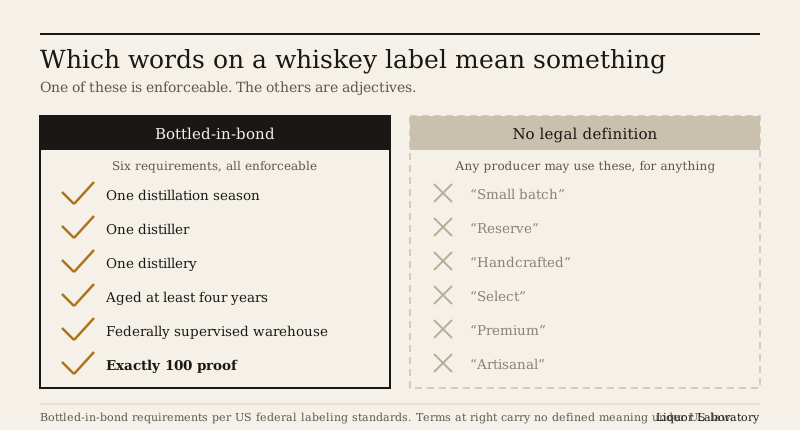
Look for "bottled-in-bond" on the label. That phrase is not marketing. Under the Bottled-in-Bond Act it is a legal claim with four requirements. The whiskey must be the product of one distillation season and one distiller at one distillery, aged at least four years, in a federally supervised warehouse, and bottled at exactly 100 proof.
No other label term at this price guarantees anything close. A bourbon can say "small batch," "reserve," "handcrafted" or "select" and mean nothing whatsoever — none of those terms has a legal definition in the United States. Bottled-in-bond means five specific things and it is enforceable.
The reason this matters more at the bottom of the shelf than the top: proof is the variable most often cut to hit a price. Dropping a bourbon from 100 proof to 80 is the cheapest way to make it cheaper, and also the fastest way to make it vanish in a cocktail. A bonded bourbon cannot do that.
Where cheap bourbon actually comes from
Most budget bourbon is made at a small number of very large distilleries. Heaven Hill, Barton 1792, Jim Beam and Buffalo Trace between them produce an enormous share of what sits on the bottom two shelves, under a wide range of brand names.
That is not a scandal. It means the liquid in an inexpensive bottle often comes off the same stills as whiskey selling for four times as much, differing in barrel selection, age and proof rather than in fundamental quality.
It also explains why the value here is real. You are not buying an inferior product. You are buying younger whiskey, at a lower proof, in a plainer bottle, with no marketing behind it.
Worth knowing: some brands are non-distiller producers — they buy whiskey from a distillery, then bottle it under their own name. This is legal and often produces good whiskey, but the label may say "produced by" or "bottled by" rather than "distilled by," and the distillery is not always named. At this price it rarely matters. At higher prices it should.
Why the same bottle costs different amounts
Spirits in the United States move through a three-tier system: producer, distributor, retailer. Each state regulates it separately, and roughly a third are control states where the state itself is the wholesaler or the retailer.
The practical result is that the same bottle of Evan Williams Bonded can vary by ten dollars or more between states, and between two shops in the same city. Any page publishing a single national price is guessing.
The bands below are indicative. Check your own shelf.
The ten
The bonded core — buy any of these with confidence
- Evan Williams Bottled-in-Bond, 100 proof. The single best value in American whiskey, and I do not say that lightly. Vanilla, char, a little baking spice, clean finish. Genuinely pleasant neat and outstanding in cocktails.
- Old Grand-Dad Bonded, 100 proof. Roughly 27% rye — the most rye-forward mainstream bourbon widely available. Peppery and dry. If you make Manhattans or Old Fashioneds, this is the bottle.
- Jim Beam Bottled-in-Bond, 100 proof. Same statutory guarantee, rounder and nuttier.
- Early Times Bottled-in-Bond, 100 proof. Frequently the cheapest bonded bourbon on the shelf and consistently decent. Corn-forward and simple.
- Heaven Hill Bottled-in-Bond, 7 year, 100 proof. A seven-year age statement at this price is unusual. Sometimes drifts just above $25 depending on market.
Not bonded, but still good
- Wild Turkey 101, 101 proof. Clears the proof bar and then some. Big, slightly funky, caramel and pepper. The standard bar workhorse.
- Old Forester 100, 100 proof. Rich and spicy with real backbone. Banana and dark fruit under the oak.
- Benchmark Old No. 8, 80 proof. Made at Buffalo Trace. Low proof, so best in a highball rather than a stirred drink, but very cheap and clean.
- Very Old Barton 100, 100 proof. Regional distribution, mostly Kentucky and the Midwest. A genuine bargain where you can find it.
- Old Ezra 7 Year, 101 proof. Seven years and 101 proof at a budget price.
Three to walk past
Anything at 80 proof priced like mid-shelf. If a bourbon sits at the legal minimum and costs $30, you are paying for the label.
Flavored whiskey. Honey, cinnamon, apple. A different product class with added sugar, and not a substitute for bourbon in any recipe.
"Small batch" or "reserve" with nothing else on the label. At the bottom of the shelf these usually mark a price increase without a change in the liquid.
How to taste cheap bourbon fairly
Budget bourbon is often judged unfairly because of how it gets poured.
Use a tulip glass, not a rocks glass. The narrowed rim concentrates aroma; a wide glass disperses it and leaves you with mostly alcohol vapor.
Add a few drops of water. At 100 proof this genuinely helps — it lowers the alcohol burn and lets the vanilla and grain come through. This is not dilution as compromise; it is standard practice among distillers and blenders.
Give it ten minutes. Young whiskey opens up with air more than old whiskey does.
Judged this way, several bottles on this list hold up against whiskey costing three times more.
How to spend $25 well
If you make cocktails: Old Grand-Dad Bonded. Rye content matters more than anything else here, because most cocktails are sweetened and rye is what pushes back.
If you drink it neat: Evan Williams Bottled-in-Bond or Heaven Hill Bonded. Both are genuinely pleasant to sip, which is not a given under $25.
If you're stocking for a party: Evan Williams Bottled-in-Bond in 1.75 L. Better per-ounce value, and 100 proof survives whatever mixer turns up.
If you're buying a gift: don't buy from this list. A cheap bottle can be a great purchase and a poor gift. Glassware or bitters lands better.
The honest truth about price and bourbon
Bourbon's price-to-quality relationship is weaker than in almost any other spirits category, and it breaks down completely at the top.
Under $25 you are paying for the liquid. Between $25 and $50 you are paying for the liquid plus some age. Above $50 you are increasingly paying for scarcity, allocation, packaging and brand — none of which you can taste.
A $22 bottle of Evan Williams Bonded is not a compromise. In a cocktail it will outperform bottles costing five times as much, because sugar, bitters and dilution flatten exactly the nuance you paid extra for.
More in our Bourbon Guide.
Frequently asked questions
What is the best cheap bourbon?
Evan Williams Bottled-in-Bond at 100 proof for most purposes. Old Grand-Dad Bonded if you make cocktails, for the high rye content.
What does bottled-in-bond mean?
A legal designation: one distillation season, one distiller, one distillery, at least four years old, aged in a federally supervised warehouse, bottled at exactly 100 proof.
Is cheap bourbon bad for cocktails?
No — often better. Sweeteners, bitters and dilution flatten subtlety, so proof matters far more than price.
What proof should cheap bourbon be?
100 if you can get it. Proof is the first thing cut to hit a price point and it is what survives mixing.
Does "small batch" mean anything?
No. It has no legal definition in the US. Bottled-in-bond does.
Why does the same bourbon cost different amounts in different states?
Three-tier distribution is regulated state by state, and about a third of states control wholesale or retail directly. Price variation of ten dollars or more on the same bottle is normal.
What is the cheapest bourbon worth buying?
Early Times Bottled-in-Bond is frequently the least expensive bonded bourbon available and it is genuinely good.
When you are ready to step up into the mid-shelf $25–$50 band, that is where bourbon’s sweet spot lives.
Sources and method
Bottled-in-bond requirements reflect US federal labeling standards. Proofs are the standard US bottling strengths as printed on current labels. Price bands are indicative and vary substantially by state under three-tier distribution. No prices or ratings are invented on this page.