Updated September 2026 by Lydia Martin
The $25 to $50 band is where bourbon is at its best, and that is not a consolation prize. It is where age, proof and barrel selection all arrive together, and it is the point at which price stops predicting quality.
Below $25 you are buying competence. Above $50 you are increasingly buying scarcity. In between, you are buying whiskey.
What actually happens in the barrel
Understanding this explains the whole price curve.
Bourbon must be aged in new charred oak containers. Not used barrels, as Scotch and Irish whiskey typically use — new ones, charred on the inside. New oak is aggressive. It gives up vanillin, tannin, caramelised wood sugars and colour far faster than a barrel on its second or third fill.
Then there is climate. Kentucky swings from freezing winters to humid summers, and warehouses are not climate controlled. As temperature rises the spirit expands into the wood; as it falls the wood pushes it back out. That cycle happens repeatedly every year, and it is what extracts flavour.
Two consequences follow:
Bourbon matures faster than Scotch. A four-year bourbon has been through more wood interaction than a four-year Scotch. This is why bourbon age statements are lower and still meaningful.
Bourbon can be over-oaked. Past roughly fifteen years, many bourbons turn bitter and drying rather than richer. This is genuinely different from Scotch, where age behaves more gently. It is also why many of the most admired bottles sit between eight and twelve years.
Warehouse position matters too. Barrels on upper floors experience bigger temperature swings and mature faster and hotter; lower floors mature slower and gentler. A distillery’s blenders are, in large part, choosing between those.
What changes at $50
Three things happen as bourbon crosses that line, and only two of them are in the glass.
Age statements appear and lengthen. Real, and worth something up to a point, for the reasons above.
Barrel proof and single barrel bottlings become common. Genuinely valuable. More flavour per ounce and control over your own dilution.
Allocation begins. Not valuable at all. When a bottle is scarce its price reflects demand rather than contents. This is where price and quality part company.
Most of the improvement you can taste happens before $50. Most of the price increase happens after.
What the label terms mean
Single barrel. The bottle came from one barrel rather than a blend. More variation between bottles, and often more character. Some retailers select their own barrels and bottle them exclusively — these “store picks” are frequently excellent value and unavailable anywhere else.
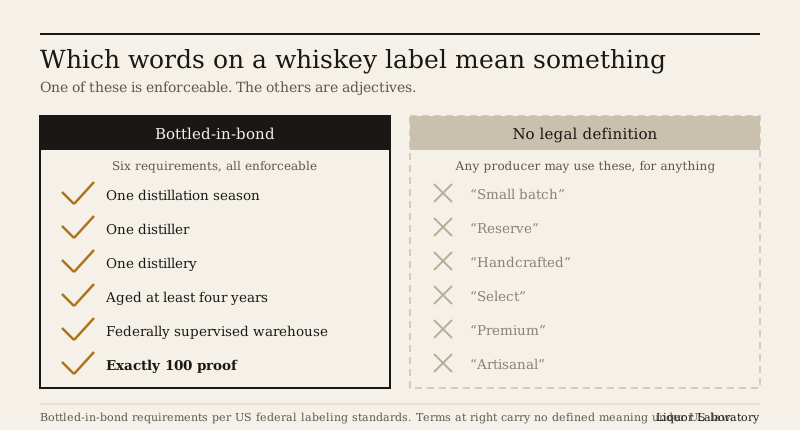
Small batch. No legal definition. It can mean twenty barrels or two hundred. Treat as marketing.
Barrel proof / cask strength. Bottled without dilution to a target proof, so strength varies batch to batch. Check the label — barrel proof is not a fixed number, and two bottles of the same expression can differ by several points.
Bottled-in-bond. Legally enforceable: 100 proof, one distillation season, one distiller, four years minimum.
Twelve bottles, by what you want
Typical shelf prices in most US markets. Three-tier distribution means these vary considerably by state.
The everyday workhorses — roughly $22–$35
- Four Roses Small Batch, 90 proof. Blends two mash bills, one at 35% rye. Stone fruit and spice together — unusual, and excellent in cocktails.
- Wild Turkey 101, 101 proof. Assertive and slightly funky. Impossible to lose in a drink.
- Buffalo Trace, 90 proof. The safe answer, though allocation has made it hard to find at shelf price in many markets. If you see it at normal price, buy it.
- Old Forester 100, 100 proof. Rich, spicy, dependable, with dark fruit under the oak.
- Elijah Craig Small Batch, 94 proof. Vanilla and toasted oak with vanilla leading. One of the best-liked bottles in the category.
A step up — roughly $35–$45
- Knob Creek 9 Year, 100 proof. A nine-year age statement at 100 proof for under $40 is a genuinely strong offer. Heavier and oakier.
- Russell’s Reserve 10 Year, 90 proof. Ten years, and it drinks like a bottle costing considerably more. One of the best-value age statements available anywhere.
- Four Roses Single Barrel, 100 proof. Single barrel, high rye, 100 proof. Consistently excellent and consistently overlooked.
- Woodford Reserve Double Oaked, 90.4 proof. Rich and dessert-like. Lovely neat, less suited to cocktails where the extra oak tannin turns drying.
The top of the band — roughly $45–$50
- Wild Turkey Rare Breed, barrel proof. Typically around 116 proof, though it varies by batch — check the label. Widely regarded as one of the best value-per-dollar bottles in all of bourbon.
- Old Forester 1920 Prohibition Style, 115 proof. Big, rich, and a genuine bargain at the proof.
- Elijah Craig Barrel Proof, varies by batch. Batch-dependent and often superb. Proof runs high.
How to drink barrel proof
If you buy Rare Breed or Elijah Craig Barrel Proof, do not treat it like a 90-proof bourbon.
Pour less and add water deliberately. A half-ounce pour with a few drops of water added a drop at a time will show you more than a full pour taken neat. Distillers taste this way.
Watch for the point where it opens. Somewhere around 100 proof most barrel-proof bourbons suddenly release aroma. Finding that point yourself is genuinely enjoyable, and it is the main argument for buying barrel proof at all.
In cocktails, adjust the build. Extend an Old Fashioned stir to 45 seconds and add slightly more syrup.
Which to buy for what
One bottle to cover everything: Four Roses Small Batch.
Best neat pour under $50: Russell’s Reserve 10 Year or Elijah Craig Barrel Proof.
Best for cocktails: Wild Turkey 101 or Four Roses Single Barrel.
Best value in the band: Wild Turkey Rare Breed.
Best gift under $50: Russell’s Reserve 10 Year. The age statement reads as generous and the whiskey justifies it.
What you are not missing above $50
Bourbon above $50 is often excellent. But the things that make it expensive are frequently not the things that make it good.
Allocated bottles cost what they cost because supply is short. Pappy Van Winkle, Weller and the Buffalo Trace Antique Collection are genuinely fine whiskeys trading at multiples unrelated to the liquid.
Packaging accounts for real money above $75.
Extreme age is a mixed proposition in bourbon specifically, for the barrel reasons above.
The improvement curve flattens hard around $50. The sensible place to spend is just below it.
More in our Bourbon Guide.
Frequently asked questions
What is the best bourbon under $50?
For overall value, Wild Turkey Rare Breed. For an everyday bottle, Four Roses Small Batch. For a neat pour with an age statement, Russell’s Reserve 10 Year.
Is expensive bourbon better?
Up to about $50, generally yes. Above that, price increasingly reflects scarcity, packaging and brand.
What’s the best bourbon under $50 for cocktails?
Wild Turkey 101 or Four Roses Single Barrel. Both 100 proof or above with meaningful rye content.
Is Buffalo Trace worth buying?
Yes, at shelf price. It is allocated in many markets, and at inflated secondary prices there are better options in this band.
What does barrel proof mean?
Bottled without dilution, so strength varies by batch. Check the label rather than assuming a fixed number.
Does age matter in bourbon?
Up to a point. New charred oak and Kentucky’s climate mature bourbon quickly, and past about fifteen years many bottles become over-oaked.
Why does bourbon age faster than Scotch?
New charred oak is far more active than the used barrels Scotch typically uses, and Kentucky’s temperature swings drive spirit in and out of the wood repeatedly each year.
The same mid-shelf bottles that shine neat also build a solid Manhattan.
Sources and method
Proofs are the standard US bottling strengths as printed on current labels; barrel proof bottlings vary by batch. Bourbon’s new charred oak requirement reflects US federal standards of identity. Price bands are indicative and vary substantially by state. No prices or ratings are invented on this page.