Updated September 2026 by Lydia Martin
Short answer: yes, and it is one of the more genuinely underpriced spirits on an American shelf. It is also widely misunderstood, and the misunderstanding starts with the letters on the label.
The label says VSOP, but that means something different here
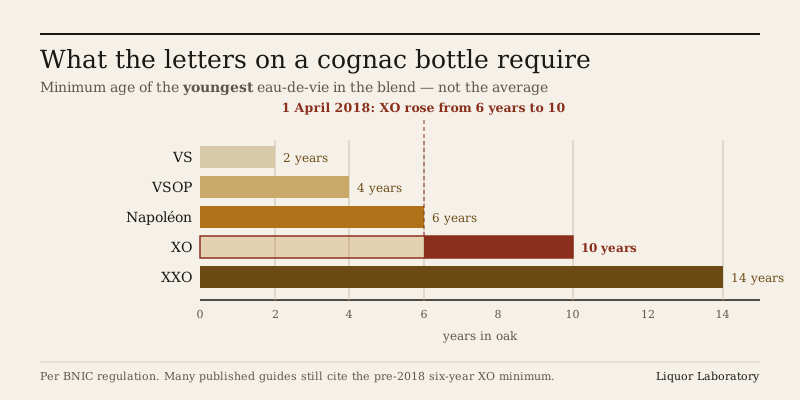
VS and VSOP are legally binding designations for cognac, enforced by the Bureau National Interprofessionnel du Cognac. VS requires two years minimum; VSOP requires four.
Paul Masson is American brandy, not cognac. Those rules have no force over it. No regulator requires an American brandy labeled VSOP to have been aged four years, or any particular length of time at all.
So the letters here are a voluntary borrowing of French terminology — a signal of intended positioning rather than a certified age claim.
To the brand's credit, it appears to honor the convention: Paul Masson states the VS is aged three years and the VSOP four years in oak. Those figures meet or exceed the cognac minimums. But you are relying on the producer's word rather than an appellation authority, and that distinction matters when you compare it to a bottle where the number is enforced.
What American brandy actually is
The United States has made brandy since the Spanish missions planted vines in California, and California has been the center of it ever since. Grapes grow abundantly in the Central Valley, and distilling surplus wine into brandy has been standard practice there for well over a century.
What American brandy lacks is a regulatory framework. There is no cru system, no appellation, no governing council, no mandatory minimum age tied to a label term. Producers choose their grapes, their stills, their barrels and their aging, and disclose as much or as little as they like.
That freedom cuts both ways. It permits inconsistency, and it also permits things cognac cannot do — most obviously the use of American oak, which gives a sweeter, more vanilla-forward, more overtly woody character than the French Limousin and Tronçais oak that cognac requires.
If a cognac tastes floral and a bourbon tastes like vanilla and caramel, American brandy sits closer to the bourbon end of that line. That is the category's signature, not a defect.
What Paul Masson is, specifically
Paul Masson Grande Amber is made from California grapes, distilled and blended in central California, then aged and bottled in Bardstown, Kentucky, alongside Sazerac's bourbon production. That is an unusual arrangement and it shows in the glass — the American oak influence is more pronounced than in a comparable cognac.
Both the VS and the VSOP are bottled at 40% ABV, 80 proof.
The name traces to Paul Masson, a French-born Californian winemaker who founded his operation in the Santa Clara Valley in the late nineteenth century and became one of the state's significant wine figures. The brandy carries that heritage as branding; the modern product is owned by Sazerac and has no operational connection to the original winery.
What it tastes like
Deep copper. Dried apricot, raisin and toffee-coated nuts on the nose, with oak spice and vanilla behind it. The palate is fruity but finishes drier than the aroma suggests, with allspice, ginger, and a note closer to espresso or cigar tobacco than to the floral register of cognac.
It reads as American. That is the point of difference.
Where it is genuinely good
Value. This is the honest headline. Paul Masson VSOP delivers a competent, oak-driven aged grape brandy at a fraction of what an entry cognac costs. Blind tastings at competition level have repeatedly shown American brandy outperforming its price bracket.
Cocktails. This is arguably its best use, and the argument is straightforward: brandy cocktails do not benefit from cognac pricing. Acidity and dilution flatten the nuance you paid for.
The Wisconsin connection. Worth knowing if you have never encountered it: Wisconsin has an outsized brandy culture, and the brandy old fashioned is effectively the state cocktail. It is made with muddled orange and cherry, brandy rather than whiskey, and topped with soda — sweet, sour, or "press" depending on preference. Nowhere else in America drinks brandy this way, and a mid-priced American brandy is exactly the right bottle for it.
Neat, at the price. It sips more comfortably than its cost suggests. Not complex, but not rough.
Where it falls short
It is not cognac and does not taste like it. American oak gives sweeter vanilla and more obvious wood than the floral, stone-fruit character of a Grande Champagne cognac. If a recipe or a person specifically wants cognac, substituting changes the drink.
No cru, no appellation, no enforced age. Nothing guarantees batch-to-batch consistency the way BNIC certification does.
Limited complexity neat. Pleasant and uncomplicated. If you want a spirit to spend an hour with, this is not it — though nothing at this price is.
The flavored line is a different product. Paul Masson also sells flavored expressions at varying strengths. Check the ABV on anything that is not Grande Amber VS or VSOP.
Four drinks to make with it
Wisconsin Brandy Old Fashioned. Muddle an orange slice, a cherry and a sugar cube with two dashes Angostura. Add 2 oz brandy and ice, top with lemon-lime soda for "sweet" or with soda water for "press." Not a bourbon old fashioned and not trying to be.
Sidecar. 2 oz brandy, 1 oz Cointreau, ¾ oz fresh lemon. Shake hard, strain, sugared rim optional. Cognac's classic, and it works with American brandy at a third of the cost.
Brandy Alexander. 1½ oz brandy, 1 oz crème de cacao, 1 oz cream. Shake, strain, grate fresh nutmeg over the top. Rich, and the American oak suits it.
Brandy and ginger ale. 2 oz brandy, ginger ale, lemon twist. Underrated, cheap, and genuinely good.
How it compares
| Category | Age rule | Character | |
|---|---|---|---|
| Paul Masson VSOP | American brandy | Voluntary, stated 4 yrs | Sweet oak, vanilla, dry finish |
| E&J VSOP | American brandy | Voluntary | Softer, sweeter |
| Korbel Brandy | American brandy | Voluntary | Lighter; the Wisconsin standard |
| Christian Brothers | American brandy | Voluntary | Sweeter, softer |
| Martell VS | Cognac | Enforced, 2 yrs min | Light, clean, nutty |
| Rémy Martin VSOP | Cognac | Enforced, 4 yrs min | Floral, stone fruit, structured |
The comparison that matters: at roughly a third of the price of an entry cognac, Paul Masson VSOP does not deliver a third of the experience. That is the whole argument for it, and it is a strong one.
More in our Brandy Guide.
Frequently asked questions
Is Paul Masson a cognac?
No. Cognac must come from the Cognac region of France. Paul Masson is American brandy made from California grapes.
What proof is Paul Masson?
Grande Amber VS and VSOP are both 40% ABV, 80 proof.
Does Paul Masson VSOP really mean four years?
The brand states four years in oak. VSOP is legally enforced only for cognac, so on American brandy it is a producer claim rather than a certified designation.
Is Paul Masson good for cocktails?
Yes, and it is arguably the best use. Sidecars, Brandy Alexanders and Wisconsin-style brandy old fashioneds all work without cognac pricing.
Who makes Paul Masson?
Sazerac. Distilled and blended in central California, then aged and bottled in Bardstown, Kentucky.
Is Paul Masson better than E&J?
They occupy the same bracket. Paul Masson generally shows more oak spice and a drier finish; E&J is softer and sweeter. Preference, not ranking.
What is a Wisconsin brandy old fashioned?
An old fashioned made with brandy instead of whiskey, muddled with orange and cherry and topped with soda. Effectively the state cocktail of Wisconsin.
What is the difference between brandy and cognac?
All cognac is brandy. Cognac must come from the delimited Cognac region, be made predominantly from Ugni Blanc, be double-distilled in copper pot stills, and be aged at least two years in French oak.
Sources and method
ABV and stated aging reflect the producer's published information and multiple retail listings. VS and VSOP are legally enforced designations for cognac under BNIC regulation; no equivalent binding requirement governs American brandy. No prices, ratings, or rankings are invented on this page.