Updated September 2026 by Lydia Martin
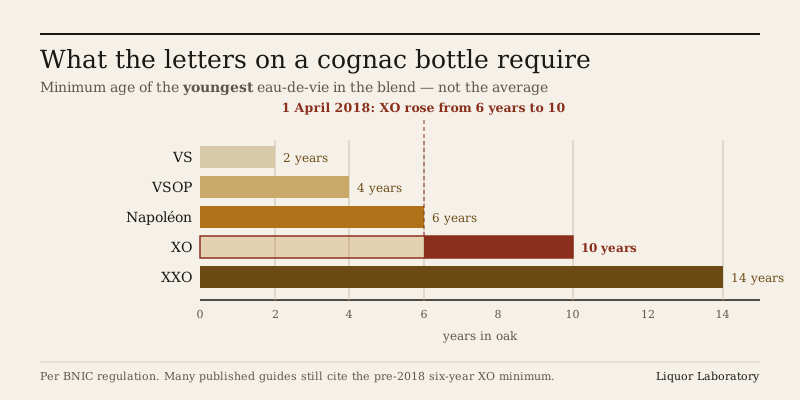
The letters on a cognac bottle are not marketing. They are legally binding age designations enforced by the Bureau National Interprofessionnel du Cognac (BNIC), and they mean something precise:
| Designation | Minimum age of youngest eau-de-vie |
|---|---|
| VS (Very Special) | 2 years |
| VSOP (Very Superior Old Pale) | 4 years |
| Napoléon | 6 years |
| XO (Extra Old) | 10 years |
| XXO (Extra Extra Old) | 14 years |
Two things about that table matter more than the numbers themselves, and most guides get at least one of them wrong.
The first thing: the age refers to the youngest component only
A cognac is blended from dozens or hundreds of eaux-de-vie of different ages. The designation tells you the age of the youngest one in the blend. Nothing else.
That means a bottle labeled XO might contain 90% spirit aged just over ten years and 10% aged thirty-five. Or it might be the reverse. Both are legally XO, and they will taste nothing alike. The system was built for trade consistency, not for transparency about what is actually in the bottle.
In practice, most XO cognacs carry an average age well above the minimum — commonly fifteen to twenty years. But that is house practice, not law.
The second thing: XO changed in 2018, and it changed a lot
Until 1 April 2018, XO required only six years. The BNIC raised it to ten, aligning regulation with what most houses were already doing and repositioning XO as a genuinely premium category. Armagnac followed with the same change later that year.
This matters when you read older material. A great deal of published cognac guidance still says XO means six years. Any guide that tells you that has not been updated in nearly a decade, which is a useful signal about the rest of its content.
Napoléon, sitting at six years, became the official bridge between VSOP and XO as a result.
What makes Rémy Martin specifically different
Rémy Martin is the only major house that bottles its entire range as Fine Champagne Cognac. That term has nothing to do with sparkling wine — champagne here derives from the Latin for open country and refers to the chalky-soil crus at the heart of the Cognac region.
Fine Champagne is a protected designation requiring the blend to come exclusively from Grande Champagne and Petite Champagne, with at least half from Grande Champagne. Those two crus produce the most structured, longest-aging eaux-de-vie in the region.
That single commitment explains the house style: floral, stone-fruit-forward, with an aging capacity that supports the extended maturation the upper range depends on.
The range
VSOP — minimum four years, and the world’s best-selling VSOP by some distance. Vanilla, apricot, baked pear, licorice. This is the bottle that belongs in cocktails; it is bright enough to survive citrus and structured enough not to vanish under it.
1738 Accord Royal — sits between VSOP and XO. Named for the year Louis XV granted the house a royal accord. Richer and more oak-driven than VSOP, with toffee and brioche. A genuinely good middle option, and often better value than pushing straight to XO.
XO — minimum ten years, typically a good deal older in practice. Dense, layered, candied orange and hazelnut with a very long finish. This is a sipping bottle and it should be treated as one.
Louis XIII — a blend of eaux-de-vie aged decades, in a Baccarat crystal decanter, priced accordingly. It exists in a different category of purchase entirely.
VSOP or XO — which should you actually buy?
This is the real question, and the honest answer is not “the more expensive one.”
Buy VSOP if you make cocktails. A Sidecar, a Vieux Carré, a Sazerac variant, a brandy old fashioned — these all want VSOP. Older cognac tends to lose nuance under acidity and dilution, and the money spent on age gets destroyed by the lemon juice. Many bartenders will not put XO in a shaker on principle, and they are right.
Buy XO if you drink it neat. The complexity that VSOP cannot reach is exactly what you are paying for, and neat is where you can perceive it.
Buy 1738 if you do both. It has enough weight to sip and enough brightness to mix.
A word on the “XO is better” assumption. A well-made VSOP from a good cru can be more expressive than a mediocre XO from indifferent casks. Age is a floor, not a guarantee. When you buy XO you are paying for age, brand equity, packaging and distribution — the price is not a pure quality signal.
How to drink it
Neat, in a tulip glass rather than a balloon snifter. The balloon disperses aroma; the tulip concentrates it. Do not warm it over a flame — that is a 1970s affectation which simply drives off alcohol vapor and burns your nose.
Sidecar — 2 oz Rémy VSOP, 1 oz Cointreau, ¾ oz fresh lemon. Shake, strain, sugared rim optional. The best argument for cognac in a cocktail.
Cognac and tonic — 2 oz VSOP, tonic, lemon twist. Underrated and increasingly common in France.
Vieux Carré — cognac and rye split evenly, sweet vermouth, Bénédictine, two kinds of bitters. Complex, and cognac’s finest showing in a stirred drink.
More in our Brandy Guide.
Frequently asked questions
What does VSOP mean?
Very Superior Old Pale. For cognac it requires the youngest eau-de-vie in the blend to be at least four years old.
How old is Rémy Martin XO?
The legal minimum is ten years for the youngest component, raised from six in April 2018. In practice XO blends commonly average considerably older.
Is XO better than VSOP?
It is older, which is not the same thing. XO is better for sipping neat. VSOP is generally better in cocktails, where extended aging is lost under citrus and dilution.
What is Fine Champagne Cognac?
A protected designation for cognac blended exclusively from the Grande Champagne and Petite Champagne crus, with at least 50% Grande Champagne. Rémy Martin bottles its whole range this way.
What is Rémy Martin 1738?
An expression positioned between VSOP and XO, named for the royal accord granted to the house in 1738.
Is cognac just brandy?
All cognac is brandy; very little brandy is cognac. Cognac must come from the delimited Cognac region, be made predominantly from Ugni Blanc grapes, be double-distilled in copper pot stills, and be aged at least two years in French oak.
For American brandy — where VSOP is a voluntary label rather than a BNIC rule — the comparison is a different article.
For a lighter, Borderies-leaning house style that distills without lees, compare Martell.
Sources and method
Age designations reflect BNIC regulations, including the XO minimum increase from six to ten years effective 1 April 2018. Fine Champagne requirements reflect the appellation rules for the Grande and Petite Champagne crus. No prices, ratings, or rankings are invented on this page.