Updated September 2026 by Lydia Martin
"Best for the money" is a different question from "best under $50," and it deserves a different answer. It is not a price ceiling. It is a ratio — how much whiskey you get per dollar — and in bourbon that ratio behaves strangely.
In most spirits categories price tracks quality reasonably well and then flattens. In bourbon it flattens early and then inverts at the top, where the most expensive bottles are frequently not the best ones.
Understanding why is the most useful thing on this page.
What happened to bourbon pricing
Bourbon nearly died. Through the 1970s and 1980s demand collapsed — consumers moved to vodka and white spirits, distilleries mothballed warehouses, and aged stock sat unsold.
That surplus is why bourbon was extraordinary value through the 1990s and early 2000s. Producers were selling twelve-year whiskey at four-year prices because they had nothing else to do with it.
Then demand returned, hard. And bourbon has a structural problem few consumer categories share so acutely: you cannot make more of it quickly. A twelve-year bourbon requires twelve years. A distillery that under-forecast demand in 2014 cannot correct that in 2026, no matter how much it invests.
Three things followed:
Age statements disappeared. Bottles that once carried them quietly dropped them, because the distillery no longer held enough old stock to guarantee the number. This is the clearest single indicator of the squeeze.
Allocation appeared. Scarce bottles get distributed in limited quantities, creating a secondary market where price reflects rarity.
Price stopped being a signal. When a bottle's cost is set by how hard it is to find, it tells you nothing about what is inside.
There is also a slower factor. Whiskey evaporates as it ages — the angel's share — and in Kentucky's climate that can run to several percent a year. A twelve-year barrel yields substantially less than it started with. Old whiskey is genuinely expensive to produce, and some of the price is real.
What you're paying for, tier by tier
| Spend | What the money buys |
|---|---|
| Under $25 | The liquid. Proof, mash bill, four years minimum. |
| $25–$50 | The liquid plus real age, higher proof, barrel selection. Best ratio in the category. |
| $50–$100 | Some genuine quality, plus packaging, brand and early scarcity. Ratio weakens. |
| $100+ | Predominantly scarcity and secondary-market demand. Ratio poor, often inverted. |
The peak sits between $25 and $50.
The sourced whiskey question
One thing worth knowing before you spend above $50.
Many brands are non-distiller producers. They buy whiskey from a large distillery, bottle it under their own name, and market it. This is legal, longstanding, and has produced some genuinely excellent whiskey.
It becomes a value question when a sourced bottle is priced as though it were the product of a small craft distillery. You may be paying a premium for a story attached to liquid made at the same plant that supplies bottles costing half as much.
How to check. Look for "distilled by" versus "produced by" or "bottled by" on the label, and for a named distillery and state. Brands that distill their own whiskey generally say so plainly, because it is their main selling point.
The bottles that beat their price hardest
Under $25 — the value floor
- Evan Williams Bottled-in-Bond, 100 proof. Bottled-in-bond guarantees 100 proof by law, one distillation season, one distiller, at least four years in a federally supervised warehouse. Nothing else at this price makes an enforceable promise. The best dollar-for-dollar bottle in American whiskey.
- Old Grand-Dad Bonded, 100 proof. Roughly 27% rye. In cocktails it outperforms bottles at four times the price.
$25–$50 — the peak
- Wild Turkey Rare Breed, barrel proof. Typically around 116 proof, batch-dependent. Barrel proof at this price is close to unique.
- Russell's Reserve 10 Year, 90 proof. A genuine ten-year age statement, increasingly rare at any price.
- Knob Creek 9 Year, 100 proof. Nine years and 100 proof for under $40.
- Four Roses Single Barrel, 100 proof. Single barrel, high rye, 100 proof.
- Old Forester 1920, 115 proof. Rich and powerful, and cheap for what it is.
$50–$100 — still defensible
- Elijah Craig Barrel Proof. Batch-dependent and frequently outstanding.
- Wild Turkey Master's Keep releases. Priced above the band but usually justified by the liquid rather than by scarcity.
Above $100 — buy for occasion, not for ratio
There are excellent bourbons here. There are almost no good values here, which is a different claim. If you want a bottle to mark something, buy one. If you want the most whiskey per dollar, you passed it forty dollars ago.
Where value is not
Allocated bottles at secondary prices. Pappy Van Winkle and the Weller line are good whiskey. At the prices they change hands for they are not good value, and anyone telling you otherwise is describing the hunt rather than the drink.
Very old bourbon. New charred oak is aggressive and Kentucky's climate is extreme, so bourbon matures fast. A twenty-year bourbon is frequently over-oaked rather than better.
Fancy bottles. Decanters, wax dips, wooden boxes. Real cost, no flavour.
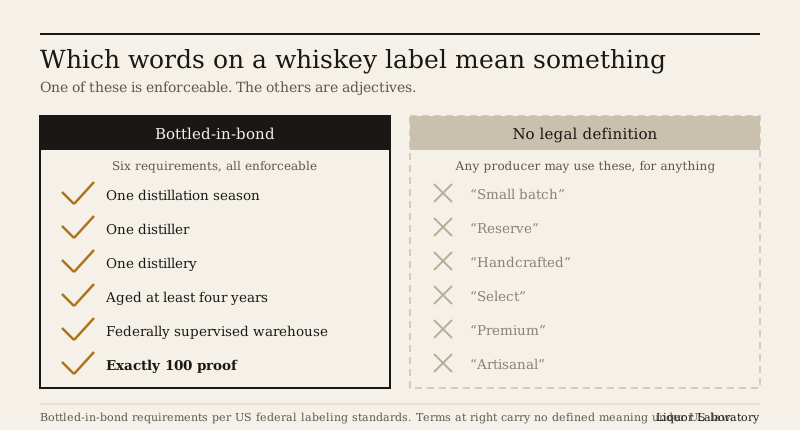
"Small batch," "reserve," "handcrafted," "select." None has a legal definition in the United States. Bottled-in-bond does. So does a stated age. So does a proof.
How to build a shelf without overspending
A genuinely good home bourbon shelf costs less than one allocated bottle.
One bonded bottle for cocktails — Old Grand-Dad Bonded or Evan Williams Bonded. Roughly $22.
One mid-shelf bottle for everyday sipping — Four Roses Small Batch or Elijah Craig Small Batch. Roughly $30.
One barrel-proof bottle for interest — Wild Turkey Rare Breed. Roughly $50.
One rye, because half the classic cocktails call for it — Rittenhouse Bottled-in-Bond. Roughly $25.
Four bottles, around $130, and they cover essentially every bourbon drink ever written plus comfortable neat sipping. Adding a fifth bottle at $200 would improve that shelf far less than most people expect.
How to buy well, in three rules
1. Read the proof, not the price. Proof is the most reliable indicator of flavour per ounce, and the first thing cut to hit a price point.
2. Prefer enforceable claims. Bottled-in-bond, a stated age, a named distillery, single barrel. These mean something. Adjectives do not.
3. Match the bottle to the use. Sugar, bitters and dilution flatten nuance, so expensive bourbon in an Old Fashioned is largely wasted. Spend on what you drink neat; save on what you mix.
More in our Bourbon Guide.
Frequently asked questions
What is the best bourbon for the money?
Evan Williams Bottled-in-Bond under $25, and Wild Turkey Rare Breed under $50.
Is expensive bourbon worth it?
Up to about $50, price and quality track reasonably well. Above that, you are increasingly paying for scarcity, packaging and brand.
Why is bourbon so expensive now?
Demand recovered faster than supply can respond. Bourbon takes years to make, so producers who under-forecast cannot correct quickly.
Is Pappy Van Winkle worth the money?
It is very good whiskey. At the prices it actually trades for it is not good value.
Does older bourbon taste better?
Not necessarily. Bourbon matures faster than Scotch, and very old bourbon is frequently over-oaked.
What is sourced whiskey?
Whiskey bought from a large distillery and bottled under another brand's name. Legal and often good, but a value question when priced as craft production.
What should I look for on a label?
Proof, an age statement, a named distillery, and "bottled-in-bond." Those are enforceable. "Small batch" and "reserve" are not.
What is the angel's share?
Whiskey lost to evaporation during ageing. In Kentucky's climate it can run to several percent a year, which is part of why old whiskey genuinely costs more to produce.
Sources and method
Bottled-in-bond requirements and bourbon's new charred oak requirement reflect US federal standards of identity. Proofs are standard US bottling strengths as printed on current labels; barrel proof bottlings vary by batch. Price bands are indicative and vary substantially by state under three-tier distribution. No prices, ratings, or rankings are invented on this page.