Updated September 2026 by Lydia Martin
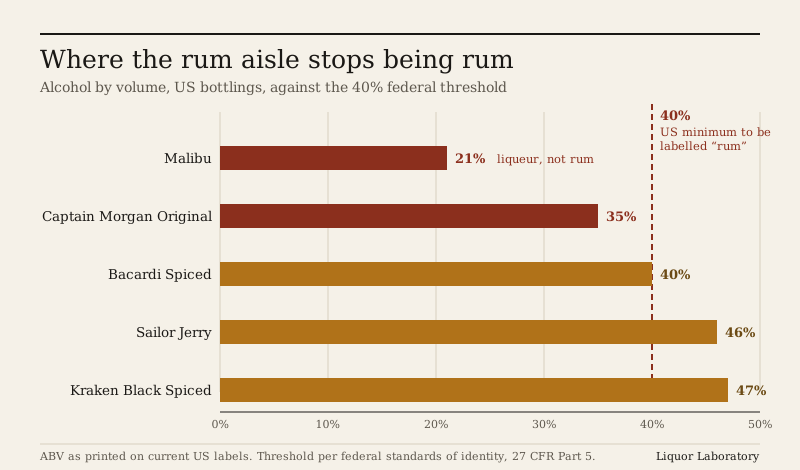
Malibu is 21% ABV — 42 proof. That is roughly half the strength of a standard bottle of rum, and it is the single most consequential thing to know about it.
It also means Malibu is not legally rum in the United States. Federal standards of identity require a product to be bottled at 40% ABV or higher to carry the word “rum” on its own. At 21%, Malibu falls well short, which classifies it as a liqueur. Pernod Ricard, which has owned the brand since 2005, markets it as a “flavored rum” in markets where local law permits that description — but the US is not consistently one of them, and you will find it shelved under rum at some retailers and under liqueurs at others.
That inconsistency is where nearly every Malibu-related cocktail failure comes from.
What is actually in the bottle
The base is white rum distilled at the West Indies Rum Distillery in Barbados, one of the oldest operating distilleries in the Caribbean. Sugarcane is processed into unrefined brown sugar, molasses is extracted, fermented with water and yeast, and then distilled through three successive stages in column stills.
That rum is then shipped onward — current blending happens primarily in Canada — where natural coconut extract and sugar are added, bringing the finished product down to 21% ABV.
So: real Caribbean rum, genuinely from Barbados, then diluted and sweetened into something quite different. The brand was created in 1978 and has defined the coconut category ever since.
Why the 21% matters more than it sounds
This is not pedantry about labels. It changes drinks.
Substitution goes wrong. If a recipe calls for coconut rum and you reach for Malibu, you are not making a like-for-like swap. Captain Morgan’s coconut expression is 35% ABV. Bacardi Coconut is 35% ABV. Malibu is 21%. Using Malibu in a recipe written for either of those gives you a drink that is roughly 40% weaker in alcohol and noticeably sweeter, because Malibu carries more added sugar to compensate for the lower proof.
Drinks come out flabby. In a piña colada, where Malibu is genuinely at home, this is fine. In something citrus-forward that was built around a full-proof spirit, the drink loses its backbone and reads as sweet without structure.
The fix is simple. When you use Malibu in place of a stronger coconut rum, either increase the pour by about half, or add a half-ounce of white rum alongside it to restore the alcohol, and cut whatever sweetener the recipe calls for.
One genuine advantage. At 21%, Malibu is forgiving. In a large-format punch or a party pitcher, it produces drinks people can consume over an afternoon without much consequence. That is a real design virtue, not a compromise — it is precisely what the product was built to do.
What it tastes like
Sweet coconut leads, with light rum warmth underneath and vanilla through the middle. Light-bodied, clean, and short on the finish. It is not complex and it is not trying to be. Judged as what it is — a ready-to-mix cocktail ingredient — it does its job well, and it took a Silver medal at the 2025 San Francisco World Spirits Competition.
Judged as a rum, it fails, because it is not one.
Where Malibu genuinely belongs
Piña colada. The drink Malibu was effectively designed for. 2 oz Malibu, 2 oz pineapple juice, 1 oz cream of coconut, blended with ice. Add a half-ounce of white rum if you want it to taste like a bar’s version.
Bay Breeze. 2 oz Malibu, 3 oz cranberry juice, 2 oz pineapple juice over ice. Genuinely good, and one of the few drinks where the low proof is a feature.
Malibu and pineapple. Two ingredients, ice, done. Not sophisticated. Reliably pleasant.
Miami Vice. Half frozen piña colada, half frozen strawberry daiquiri, poured to layer. Malibu carries the colada half properly.
Large-format punch. Where the low ABV lets you build something sessionable without watering it down.
Where it does not belong
A daiquiri or a mojito. These want a dry white rum. Malibu’s sugar collapses them.
Anything you want to taste like rum. The coconut is the point, and it dominates completely.
Neat or on the rocks. It is a mixer. Sweet at 21% with nothing to balance it is heavy going.
Malibu compared to the alternatives
| ABV | Character | |
|---|---|---|
| Malibu | 21% | Sweetest, lowest proof, richest coconut |
| Parrot Bay | ~21% | Similar strength, more candied |
| Bacardi Coconut | 35% | More rum backbone, less sweet |
| Captain Morgan Coconut | 35% | Stronger, more spirit-forward |
| Coconut cream + white rum | varies | Full control over sweetness and strength |
That last row is worth taking seriously. If you make coconut drinks regularly, white rum plus cream of coconut gives you better drinks than any pre-sweetened coconut spirit, because you decide the ratio.
More in our Rum Guide.
Frequently asked questions
Is Malibu a rum?
The base is Caribbean rum, but the finished product is 21% ABV, below the 40% minimum required to be labeled simply “rum” in the US. It is a rum-based coconut liqueur.
What is Malibu’s alcohol content?
21% ABV, or 42 proof.
Is Malibu strong?
No. It is roughly half the strength of standard rum and among the weakest spirits on the shelf.
What is Malibu made from?
White rum distilled in Barbados from sugarcane molasses, blended with natural coconut extract and sugar.
Can you substitute Malibu for coconut rum?
Not directly. Coconut rums are typically 35% ABV. Increase the Malibu pour by about half, or add white rum alongside it, and reduce the recipe’s sweetener.
Does Malibu need refrigeration?
No, though chilled is how most people prefer it. Because of the sugar and lower alcohol, finish an open bottle within a year or so.
Who owns Malibu?
Pernod Ricard, since 2005. The brand launched in 1978.
Sources and method
ABV confirmed against the producer’s published information and multiple retail listings. The 40% ABV labeling threshold reflects US federal standards of identity for distilled spirits. Competition result: Silver, San Francisco World Spirits Competition, 2025. No prices are invented on this page.