Updated March 2026.
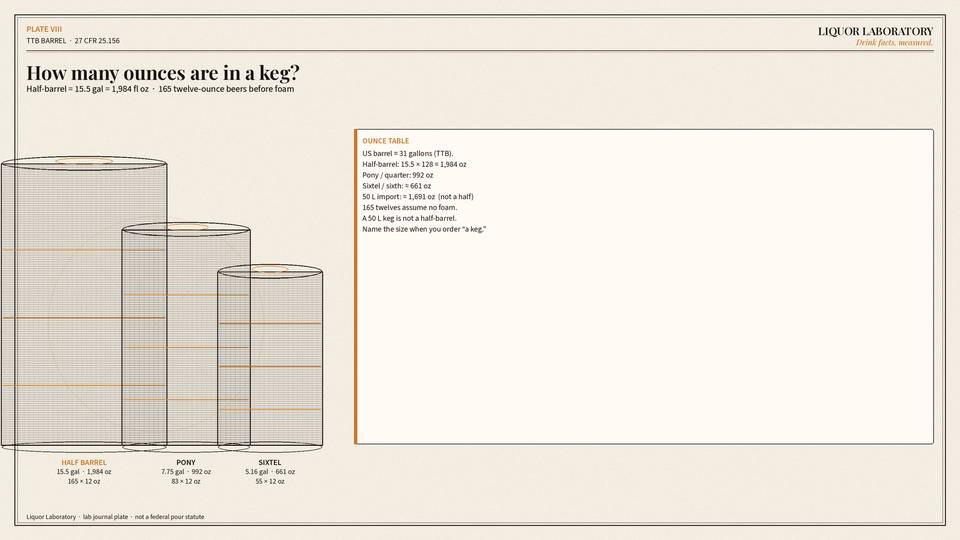
A US half-barrel keg — the one people mean by “a keg” — holds 15.5 US gallons, which is 1,984 fluid ounces. That is 165 twelve-ounce beers, or 124 sixteen-ounce pints, before foam and the unpourable heel. A quarter-barrel (“pony”) is 7.75 gallons / 992 ounces. A sixth-barrel (“sixtel”) is about 5.16 gallons / 661 ounces.
TTB treats a beer barrel as 31 US gallons (27 CFR 25.156). Kegs are fractions of that barrel, plus a few metric sizes.
US keg sizes in ounces
| Keg | US gallons | Fluid ounces | 12 oz beers | 16 oz pints | Barrel fraction (TTB) |
|---|---|---|---|---|---|
| Full barrel (rare at retail) | 31 | 3,968 | 331 | 248 | 1 |
| Half barrel / “full keg” | 15.5 | 1,984 | 165 | 124 | 1/2 |
| Quarter barrel / pony | 7.75 | 992 | 83 | 62 | 1/4 |
| Sixth barrel / sixtel | 5.16 | 661 | 55 | 41 | 1/6 |
| Cornelius / homebrew “corny” | 5.0 | 640 | 53 | 40 | authorized 5-gal keg |
| 50-liter import keg | 13.2 | 1,691 | 141 | 106 | 50 L listed in § 25.156 |
| 30-liter keg | 7.93 | 1,014 | 85 | 63 | 30 L listed in § 25.156 |
Ounces: 1 US gallon = 128 fl oz, so 15.5 × 128 = 1,984. The sixth-barrel is 31 ÷ 6 = 5.1667 gallons × 128 ≈ 661 oz. Anheuser-Busch’s own barrel spec sheet uses 15.5 / 7.75 / 5.166 gallons and 1,984 / 992 / 661 ounces — the same numbers.
What you actually pour
Those 165 twelves assume every ounce leaves the keg as beer. Foam, a badly packed coupler, and the last unpourable inch steal servings. Plan on losing a few beers, not gaining them. A party cup marked 16 ounces is often filled to 12–14. For pitcher math see how much is in a pitcher of beer. For weight, how much a case of beer weighs is a different container.
European 50 L kegs show up under import brands. They are not half-barrels. If the invoice says 50 L, use 1,691 ounces, not 1,984.
Keg vs case
A half-barrel’s 1,984 ounces ÷ 288 ounces in a 24-pack of 12-ounce cans ≈ 6.9 cases. A sixtel is about 2.3 cases. That is volume, not a price list. Deposit, coupler type (D-system Sankey is the US standard for most domestic lagers; other brands use S, A, G, or U) and whether the shop sells the tap are separate from the ounce count.
Pints, cups, and the leftover inch
US bars sell a pint as 16 ounces. A party cup labeled 18 ounces is not an 18-ounce pour unless someone fills it. Using 16-ounce pints, a half-barrel is 124; using 12-ounce cups it is 165. Metric 50 L kegs are billed as 50 L, which is 1,690.7 US fl oz if you convert 1 L = 33.814 oz. TTB’s 50-liter barrel equivalent in § 25.156 is 0.42608 of a 31-gallon barrel — the tax math, not a different physical keg.
Sixth-barrels are the craft-bar default because they fit more brands on one box. Two sixtels are 10.33 gallons, still short of a half-barrel’s 15.5. Do not order “a keg” on the phone without naming the size. For what that keg costs, how much is a keg of beer — volume here, price there.
Weight is not ounces, but people ask
A full half-barrel is often cited around 160 pounds (beer plus the steel). A sixtel full is often cited around 55–60 pounds. Those are industry rules of thumb, not a TTB weight. The ounce count does not change if the keg is stainless or a one-way PET. Foam still steals glasses. If you are shopping a party against cans, 1,984 ounces versus a 30-pack’s 360 ounces is the comparison that matters; see how much a keg costs and how much a case of beer weighs.
Sources
- 27 CFR 25.156: a barrel is not more than 31 gallons; authorized fractions include halves, quarters, sixths; 5 gal, 30 L, and 50 L kegs listed.
- 27 CFR 25.11: barrel, as a unit, = 31 US gallons.
- US gallon = 128 fl oz (NIST Handbook 44 / customary units).