Updated November 2026
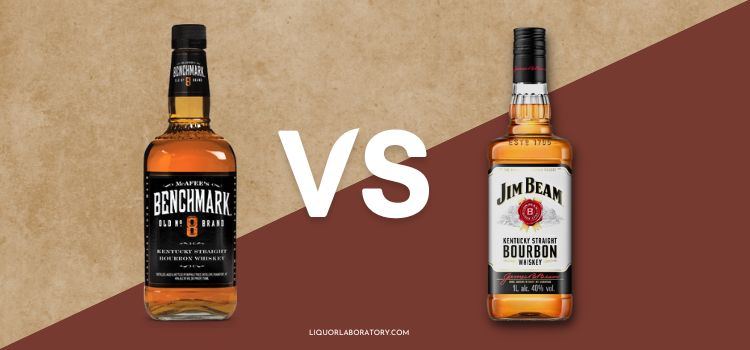
Benchmark Old No. 8 and Jim Beam Original (White Label) are both 80 proof Kentucky straight bourbons, but they come from different distilleries and different recipes. Benchmark is made at Buffalo Trace Distillery in Frankfort on what the distillery calls Mash Bill #1, while Jim Beam is made by the Beam family brand and carries a four year age statement. Benchmark leans toward caramel, stone fruit and dry tobacco; Jim Beam leans toward oak, vanilla and a nutty, spicy backdrop. Both are built for mixing first.
If you are standing in front of the bottom shelf trying to pick one, the short version is this: choose by flavor, not by status. Neither bottle is a sipping showpiece, and both do their best work with ice, soda or citrus. Details below come from producer pages, state liquor board listings and federal rules.
Benchmark vs Jim Beam at a glance
| Detail | Benchmark Old No. 8 | Jim Beam Original |
|---|---|---|
| Proof (ABV) | 80 proof (40%) | 80 proof (40%) |
| Type | Kentucky straight bourbon | Kentucky straight bourbon |
| Producer | Buffalo Trace Distillery (Sazerac) | Jim Beam (Beam family brand, since 1795) |
| Age on label | No age statement | Aged 4 years |
| Recipe | Buffalo Trace Mash Bill #1 (low rye) | Beam’s own low rye recipe |
| Producer tasting notes | Caramel, stone fruit, leather, dry tobacco, oak, dried cherry | Oak, vanilla, spice, caramel, toasted oak finish |
| Best use | Highballs, Old Fashioned, whiskey sour | Highballs, Kentucky Sunrise, Old Fashioned |
What makes both of them bourbon
Under federal labeling rules, 27 CFR § 5.143 says bourbon must come from a mash of at least 51% corn, be distilled at 160 proof or less, and go into new charred oak barrels at 125 proof or less. The word “straight” adds a minimum of two years in those barrels. Both Benchmark and Jim Beam meet those rules, so the gap between them is about recipe, barrel time and house style, not about one being “real” bourbon and the other not.
Age labeling matters here too. Under 27 CFR § 5.74(b), a whiskey aged less than four years must carry an age statement. Jim Beam states its age outright: four years, which the brand describes as “twice what the law requires.” Benchmark Old No. 8 carries no age statement on the bottle, so check the label of the bottle you buy if age matters to you.
If you want the longer background on Beam’s classification, our page on is Jim Beam bourbon covers it.
Where each bottle comes from
Benchmark
Benchmark began under Seagram in the late 1960s as a premium bourbon in a decanter style bottle. The Sazerac Company bought the brand in 1989, and it is now made at the Buffalo Trace Distillery in Frankfort, Kentucky. For years the label read “McAfee’s Benchmark,” a nod to the McAfee brothers who surveyed the land where the distillery now stands in 1773. Buffalo Trace calls Old No. 8 “the original expression of the Benchmark family.”
That family has grown. Recent reviews list Benchmark Small Batch (90 proof), Top Floor (86 proof), Single Barrel (95 proof), Bonded (100 proof) and a barrel proof Full Proof bottling. The Bonded version follows 27 CFR § 5.88, which requires one distilling season at one distillery, at least four years in wood, and bottling at 100 proof.
Since Benchmark and Buffalo Trace bourbon share a distillery, our Benchmark vs Buffalo Trace comparison is the natural next read.
Jim Beam
Beam dates its bourbon making to 1795 and describes seven generations of the Beam family behind the brand. Jim Beam Original, often called White Label, is the flagship: Kentucky straight bourbon, aged four years. North Carolina’s ABC Commission lists it as “Jim Beam 4Y” at 80 proof. For the full lineup of Beam strengths, see Jim Beam proof.
How they taste
Here is how each producer describes its own bourbon.
Benchmark Old No. 8
Buffalo Trace says the nose “bears caramel notes with a delicate stone-fruit backdrop,” the palate is “robust and sturdy” with “fine leather notes mingling with dry tobacco, a touch of oak and a hint of dried cherries,” and the finish is “smooth and calming.”
Jim Beam Original
Beam describes the color as “light caramel,” the aroma as “oak, vanilla, and a spicy backdrop,” the taste as “medium-bodied, mellow hints of caramel and vanilla,” and the finish as “toasted oak with some sweetness.”
Why they taste different
Neither distillery publishes exact grain percentages for these bottles. Paste Magazine’s 2020 guide to Kentucky house styles describes Beam’s low rye recipe as roughly 75% corn, 13% rye and 12% malted barley, and notes the nutty, “peanut shell” character many drinkers find in young Beam bourbon. The same guide says Buffalo Trace Mash Bill #1 is “said to consist of less than 10% rye” and leans toward caramel, vanilla and cherry like fruit. In short, Benchmark reads fruitier and drier, Jim Beam nuttier and more vanilla forward.
Which one should you buy?
- Pick Benchmark if you like the Buffalo Trace house style and want caramel, dark fruit and a dry tobacco edge in a highball or a simple Old Fashioned.
- Pick Jim Beam if you want a stated four year age, a familiar vanilla and oak profile.
- Want more strength from the same family? Step up to Benchmark Bonded at 100 proof, or look at the higher proof Beam bottles on our proof page.
- Want to taste them yourself? Pour half an ounce of each side by side, neat, then add a splash of water. The difference shows up fastest that way.
Shopping beyond these two? Our best cheap bourbon list covers other everyday bottles.
How to drink them
At 80 proof, both bourbons are gentle enough for long drinks. Beam itself suggests an Old Fashioned and a Kentucky Sunrise (bourbon with orange juice and grenadine). Good starting points for either bottle:
- Bourbon and ginger ale: 2 oz bourbon, 4 oz ginger ale, ice, lime wedge.
- Old Fashioned: 2 oz bourbon, 1 sugar cube or a barspoon of simple syrup, 2 dashes Angostura bitters, stir over ice, orange peel.
- Whiskey sour: 2 oz bourbon, 3/4 oz lemon juice, 3/4 oz simple syrup, shake with ice.
For more ideas, see what to mix with Jim Beam and our Jim Beam drink recipes, which work just as well with Benchmark. If you are pacing a night of whiskey drinks, remember both are 40% alcohol by volume, so a standard 1.5 oz pour of either carries the same alcohol.
Benchmark vs Jim Beam FAQ
Is Benchmark the same as Buffalo Trace?
No. Both are made at Buffalo Trace Distillery, and Buffalo Trace lists Benchmark Old No. 8 on Mash Bill #1, but they are separate brands bottled at different strengths.
Is Jim Beam or Benchmark stronger?
Neither. Benchmark Old No. 8 and Jim Beam Original are both 80 proof, or 40% ABV, according to the producers and North Carolina ABC listings.
How old is Jim Beam White Label?
Jim Beam Original is labeled as aged four years, which the brand describes as twice the legal minimum for straight bourbon.
Does Benchmark have an age statement?
Benchmark Old No. 8 carries no age statement on its label. Under 27 CFR § 5.74(b), whiskey younger than four years must state its age, so check the bottle in front of you for the current label.
Which is better for mixing?
Both mix well. Benchmark brings more dried fruit and tobacco to a cocktail, while Jim Beam brings more vanilla and oak. Choose the one whose flavor you prefer in the drink you are making.
Sources
- Buffalo Trace Distillery, Benchmark Old No. 8 Brand product page (proof, Mash Bill #1, tasting notes).
- Jim Beam, Jim Beam Original product page, jimbeam.com (aged 4 years, tasting notes, serving ideas); Beam Distilling, Jim Beam Bourbon page (80 proof, 1795, seven generations).
- North Carolina ABC Commission product listings: Benchmark Old #8 (80 proof) and Jim Beam 4Y (80 proof).
- 27 CFR § 5.143 (bourbon and straight whisky), § 5.74 (age statements) and § 5.88 (bottled in bond), via Cornell Law School LII.
- Wikipedia, McAfee’s Benchmark (Seagram origin, 1989 Sazerac purchase, McAfee brothers).
- Uproxx, Buffalo Trace Benchmark bourbon lineup (expression proofs).
- Paste Magazine, Jim Vorel, guide to Kentucky bourbon distillery house styles, 19 Oct 2020 (mash bill descriptions).