Updated November 2026
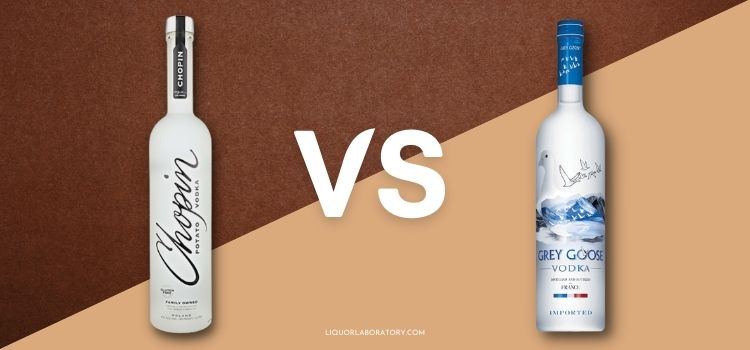
Chopin and Grey Goose are both 80 proof (40% ABV) premium vodkas, but they start from different raw materials and taste different because of it. Chopin’s flagship is a Polish potato vodka made by the Dorda family near Krzesk in eastern Poland, and it is creamy, full bodied and earthy. Grey Goose is a French vodka made from soft winter wheat grown in Picardy and blended in Cognac with limestone-filtered spring water, and it is lighter and cleaner, with a hint of almond. Pick Chopin for a rich, textured Martini or sipping cold; pick Grey Goose for a crisp vodka soda or an easygoing all-purpose pour.
This guide compares the two on ingredients, production, what the producers say about taste, how they mix and which to buy. For the wider category, see our Vodka Guide.
Chopin vs Grey Goose at a glance
| Chopin Potato Vodka | Grey Goose | |
|---|---|---|
| Country | Poland | France |
| Base | Potatoes (Chopin also makes rye and wheat vodkas) | Soft winter wheat from Picardy |
| Proof / ABV (US) | 80 proof / 40% | 80 proof / 40% |
| Where it is made | Family estate near Krzesk, eastern Poland | Distilled in northern France, blended and bottled in Cognac |
| Water | Artesian spring beneath the estate | Limestone-filtered spring water from Gensac-la-Pallue |
| Brand launched | 1993 | 1997 |
| Owner | The Dorda family | Bacardi (since 2004) |
| Texture and taste | Creamy, full bodied, earthy, gently spicy | Clean, fresh, light, hint of almond |
| Standard drinks per 1.5 oz | 1.0 | 1.0 |
What makes both of them vodka
In the United States, vodka is a type of neutral spirits under 27 CFR § 5.142. Neutral spirits are distilled from any material at or above 190 proof and bottled at no less than 80 proof, and vodka may be treated with up to two grams per liter of sugar and up to one gram per liter of citric acid. Because neutral spirits can come from “any material,” a potato vodka and a wheat vodka are equally legitimate. Both Chopin Potato and Grey Goose sit right at the 80 proof floor in the US; North Carolina’s ABC Commission lists Chopin Potato at 80 proof, and Grey Goose’s US listings show 40% ABV.
The differences between premium bottles are subtle and come mainly from the base ingredient, the stills, the water and how the spirit is filtered. Our guide to what vodka tastes like explains how each base changes the flavor.
Chopin: the Polish potato vodka
Chopin launched in 1993 and is made at a family-owned distillery near the hamlet of Krzesk in eastern Poland. The brand says the Dorda family took over the business in 2003, that its ingredients are grown within 20 miles of the distillery, and that its water comes from an artesian spring beneath the 17-acre estate. The potato vodka starts with a high-starch potato variety planted in spring and harvested in September. The potatoes are washed and steam cooked into a mash, fermented for about two weeks with the distillery’s own yeast strain, then distilled in a copper still the brand dates to 1896.
Chopin calls its range “single-ingredient” vodkas: one made from potatoes, one from rye and one from wheat, so you can taste the effect of the base side by side. The brand describes its potato vodka as “creamy, full-bodied and naturally gluten-free.” Falstaff’s tasting panel notes “freshly cut potatoes” and earthy tones on the nose, a palate that is “full-bodied” with “a dense texture” and well developed spice, and a long finish. That weight is what most drinkers notice first: potato vodka feels almost oily on the tongue next to a wheat vodka.
Grey Goose: the French wheat vodka
Sidney Frank, founder of Sidney Frank Importing Co., created Grey Goose in 1997, and Bacardi bought the brand in 2004. The original recipe was developed by François Thibault, the brand’s Maître de Chai and a former cognac producer. Grey Goose uses soft winter wheat from the Picardy region of northern France, where it is distilled, then sends the spirit to Cognac to be blended with spring water from Gensac-la-Pallue that has been naturally filtered through limestone. The brand says it uses a single five-stage distillation and one filtration, with no additives.
Grey Goose describes its vodka as having “an exquisite clear, fresh and elegantly aromatic taste,” with “subtle hints of almond and a long, satisfying finish.” Compared with Chopin it feels lighter and softer, with a gentle bready sweetness from the wheat. For a closer look, read our Grey Goose vodka review or see how it compares with a grape vodka in Cîroc vs Grey Goose.
How they taste side by side
- Texture: Chopin is noticeably creamier and heavier. Grey Goose is lighter and silkier.
- Aroma: Chopin shows earthy, potato skin notes. Grey Goose is cleaner, with a faint floral and almond character.
- Sweetness: Both are dry. Grey Goose has a soft grain sweetness; Chopin a rounder, fuller feel rather than sweetness.
- Finish: Chopin’s finish is longer and a little spicy. Grey Goose finishes clean and smooth.
Which is better for cocktails?
- Martini: Chopin’s body gives a richer, rounder Martini; Grey Goose gives a crisper, cleaner one. For a briny version, see our best vodka for a dirty Martini.
- Vodka soda and tonic: Grey Goose’s lighter profile disappears neatly into a highball.
- Espresso Martini: Either works. The IBA spec calls for 50 ml vodka, 30 ml coffee liqueur, 10 ml sugar syrup and one shot of espresso; Chopin adds a little extra body. More picks are in our best vodka for an Espresso Martini guide.
- Sipping cold: Chopin is the more interesting bottle to sip on its own, because the potato character is easy to pick out. Our list of the best vodka to drink straight has other options.
Strength and standard drinks
A US standard drink is 14 grams of alcohol, the amount in 1.5 oz of 40% ABV spirit. Because both vodkas are 80 proof, a 1.5 oz pour of either is one standard drink (1.5 oz x 0.40 = 0.6 oz of alcohol), and a 750 mL bottle holds about 17 standard drinks. Our guide to how many shots of vodka it takes to feel the effects explains the math. Never drink and drive.
Which should you buy?
Buy Chopin if you want a vodka with real texture and character, especially for a stirred Martini or sipping chilled, or if you are curious how much the base ingredient matters. Buy Grey Goose if you want a clean, smooth, easy-to-find vodka that works in almost any mixed drink. Want more comparisons? Read Ketel One vs Tito’s or browse our vodka overview.
Frequently asked questions
Is Chopin vodka made from potatoes?
The flagship Chopin Potato Vodka is. Chopin also makes a rye vodka and a wheat vodka, each from a single base ingredient, so check which bottle you are buying.
Is Chopin or Grey Goose stronger?
Neither. Both flagship bottles are 80 proof (40% ABV) in the US. Flavored or special releases can differ, so check the label.
Which is smoother, Chopin or Grey Goose?
Both are marketed as smooth. Grey Goose feels lighter and softer, while Chopin feels creamier and fuller. Which one seems smoother depends on whether you prefer a light or a rich texture.
Who owns Chopin vodka?
Chopin is family owned. The brand says the Dorda family took over the business in 2003 and still runs the estate distillery near Krzesk, Poland.
Sources
- 27 CFR § 5.142 (neutral spirits and vodka standards of identity), via Cornell Legal Information Institute.
- Chopin Vodka, distillery page (Krzesk estate, Dorda family since 2003, ingredients within 20 miles, artesian spring, high-starch potatoes, two-week fermentation, 1896 copper still) and product pages (potato, rye and wheat vodkas).
- VinePair, Q and A with Tad Dorda (brand launched 1993, single-ingredient potato, rye and wheat vodkas, Krzesk distillery).
- Falstaff, Chopin Potato Vodka tasting note (40% ABV).
- North Carolina ABC Commission product listing, Chopin Potato (80 proof).
- Grey Goose, brand and process pages and US retailer listing (Picardy wheat, Gensac-la-Pallue spring water, single five-stage distillation, 40% ABV, brand tasting notes).
- Wikipedia, “Grey Goose (vodka)” (Sidney Frank, 1997, Bacardi 2004, François Thibault).
- National Institute on Alcohol Abuse and Alcoholism, “What Is a Standard Drink?”