Updated November 2026
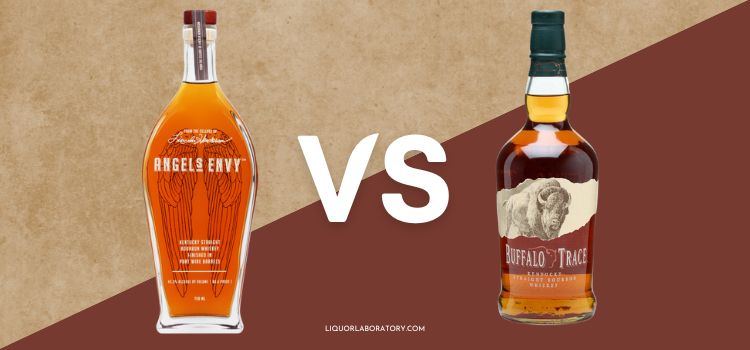
Angel’s Envy and Buffalo Trace are both Kentucky straight bourbons, but they take different routes to the glass. Angel’s Envy is an 86.6 proof (43.3% ABV) bourbon from Louisville that spends its last three to six months in ruby port wine barrels, which adds dried fruit and a soft, sweet finish. Buffalo Trace is a 90 proof (45% ABV) bourbon from Frankfort aged only in new charred oak, with a classic profile of vanilla, brown sugar and spice. Pick Angel’s Envy for a mellow, fruit-forward sipper; pick Buffalo Trace for a traditional bourbon that sips well and mixes even better.
This guide compares how each is made, how the producers describe the taste, the strength in standard drinks, and which suits sipping or cocktails. New to the category? Start with our Bourbon Guide.
Angel’s Envy vs Buffalo Trace at a glance
| Angel’s Envy | Buffalo Trace | |
|---|---|---|
| Label | Kentucky Straight Bourbon Whiskey Finished in Port Wine Barrels | Kentucky Straight Bourbon Whiskey |
| Proof / ABV | 86.6 proof / 43.3% | 90 proof / 45% |
| Distillery | Angel’s Envy, downtown Louisville, KY | Buffalo Trace Distillery, Frankfort, KY |
| Owner | Bacardi (since 2015) | Sazerac Company (since 1992) |
| Mash bill | 72% corn, 18% rye, 10% malted barley (reported for the Louisville distillery) | Mash Bill #1 (recipe not published) |
| Extra step | 3 to 6 months in 60-gallon ruby port barrels | None; new charred oak only |
| Standard drinks per 1.5 oz | About 1.1 | About 1.1 |
| Best use | Neat, on a large cube, after dinner | Neat, Old Fashioned, Manhattan, highballs |
What makes both of them straight bourbon
Under US federal rules at 27 CFR § 5.143, bourbon must be made in the United States from a mash of at least 51% corn, distilled to no more than 160 proof, entered into new charred oak containers at no more than 125 proof, and bottled at 80 proof or higher, with no added coloring, flavoring or blending materials. “Straight” bourbon has spent at least two years in those new charred containers.
The port finish is where Angel’s Envy departs from the usual script. Nothing is added to the whiskey; it simply rests in a second, used barrel that once held port. Because that step goes beyond the basic bourbon recipe, the label pairs the class name with a plain statement of the finish: “Finished in Port Wine Barrels.” Buffalo Trace has no such statement because it never leaves new charred oak.
Age is the other label clue. Under 27 CFR § 5.74, a straight whisky aged less than four years must state its age on the label. Neither flagship carries an age statement, which tells you each is at least four years old; neither producer publishes an exact age beyond that floor.
Angel’s Envy: the port-finished bourbon
Angel’s Envy was created by Lincoln Henderson, a retired Brown-Forman master distiller and an inaugural member of the Bourbon Hall of Fame, together with his son Wes Henderson. The original idea was to take finished bourbon and give it a second rest in used port wine casks. Bacardi acquired the brand and its parent company in March 2015, while the Henderson family stayed involved. The brand’s own distillery in downtown Louisville began distilling in October 2016 and opened to visitors that November, running a column still on a reported mash of 72% corn, 18% rye and 10% malted barley.
The finishing step uses 60-gallon French oak ruby port barrels imported from Portugal. The bourbon stays in them for three to six months, depending on taste, and is blended in small batches of 8 to 12 barrels, so each release can vary slightly.
The brand describes the color as gold with reddish amber hues, nearly copper; the nose as subtle vanilla, raisins, maple syrup and toasted nuts; and the palate as vanilla, ripe fruit, maple syrup, toast and bitter chocolate, with a clean finish, lingering sweetness and a hint of Madeira. The rest of the lineup is covered in our guide to the Angel’s Envy bourbon line.
Buffalo Trace: the classic new-oak bourbon
Buffalo Trace is the namesake bourbon of the Buffalo Trace Distillery in Frankfort. The Sazerac Company bought the distillery in 1992 and launched the Buffalo Trace brand in 1999. The site was designated a National Historic Landmark in 2013.
The bourbon is made from the distillery’s Mash Bill #1, whose percentages are not published but which is generally understood to be lower in rye than many competitors. Buffalo Trace describes it as deep amber with a complex aroma of vanilla, mint and molasses; pleasantly sweet on the palate with brown sugar and spice giving way to oak, toffee, dark fruit and anise; and a long, smooth finish.
How they taste side by side
- Sweetness: Both are sweet, but in different ways. Angel’s Envy leans toward maple, raisin and red fruit from the port; Buffalo Trace leans toward brown sugar, toffee and vanilla.
- Spice: Buffalo Trace shows more classic bourbon spice and a touch of mint. Angel’s Envy’s spice is softer, tucked behind the fruit.
- Body and heat: Buffalo Trace’s extra 3.4 proof gives it slightly more grip. Angel’s Envy reads rounder and gentler.
- Finish: Angel’s Envy ends with lingering sweetness and a wine-like note; Buffalo Trace ends long, with oak and anise.
Still deciding? Compare each against other popular bottles: Angel’s Envy vs Basil Hayden, Basil Hayden vs Buffalo Trace, Buffalo Trace vs Jack Daniel’s and Wild Turkey 101 vs Buffalo Trace. If you love the port-finished style, see bourbons similar to Angel’s Envy.
Strength and standard drinks
A US standard drink contains 14 grams of alcohol, the amount in 1.5 ounces of 40% ABV spirit (0.6 oz of pure alcohol). Here is the math for a 1.5 oz pour:
- Angel’s Envy (43.3%): 1.5 oz x 0.433 = about 0.65 oz of alcohol, or about 1.1 standard drinks.
- Buffalo Trace (45%): 1.5 oz x 0.45 = 0.675 oz of alcohol, or about 1.1 standard drinks.
Across a 750 mL bottle (about 25.4 oz), that is roughly 18 standard drinks of Angel’s Envy and 19 of Buffalo Trace. Our guide to how much whiskey it takes to feel the effects explains standard drinks in more detail. Never drink and drive.
Which one should you buy?
- You want something smooth and dessert-like to sip neat: Angel’s Envy. The port finish makes it approachable for people who find standard bourbon too sharp.
- You want one bottle for sipping and cocktails: Buffalo Trace. Its sweetness and 90 proof hold up in an Old Fashioned or a Manhattan; see our best bourbon for a Manhattan guide.
- You can only find one: Buffalo Trace is allocated in some markets, so availability may decide for you.
For the bigger picture on how bourbon fits into American whiskey, read bourbon vs whiskey.
Frequently asked questions
Is Angel’s Envy or Buffalo Trace stronger?
Buffalo Trace, slightly. It is 90 proof (45% ABV), while Angel’s Envy is 86.6 proof (43.3% ABV). Both work out to about 1.1 US standard drinks per 1.5 oz pour.
Are Angel’s Envy and Buffalo Trace made at the same distillery?
No. Angel’s Envy is made in downtown Louisville and owned by Bacardi. Buffalo Trace is made at the Buffalo Trace Distillery in Frankfort and owned by the Sazerac Company.
Does the port finish add sugar or flavoring to Angel’s Envy?
No. Bourbon cannot contain added flavoring or coloring under 27 CFR § 5.143. The fruit notes come from the whiskey resting for three to six months in barrels that previously held ruby port.
Sources
- Angel’s Envy producer notes as published by Wine.com (43.3% ABV, ruby port finish of three to six months in 60-gallon French oak barrels, tasting notes).
- Bacardi Limited, “Bacardi Acquires Angel’s Envy Bourbon,” March 30, 2015 (Lincoln Henderson, Wes Henderson, Bourbon Hall of Fame, 8 to 12 barrel batches).
- Alcohol Professor, “Angel’s Envy Distillery Now Open in Downtown Louisville,” November 2016 (opening, column still, 72/18/10 mash bill, original sourcing concept).
- Buffalo Trace Distillery, Buffalo Trace Bourbon product information (90 proof, Mash Bill #1, tasting notes).
- Wikipedia, “Buffalo Trace Distillery” (Sazerac purchase 1992, brand launch 1999, National Historic Landmark 2013, brands made).
- 27 CFR § 5.143 (whisky and bourbon standards of identity) and 27 CFR § 5.74 (age statements), via Cornell Legal Information Institute.
- National Institute on Alcohol Abuse and Alcoholism, “What Is a Standard Drink?”