Updated October 2026
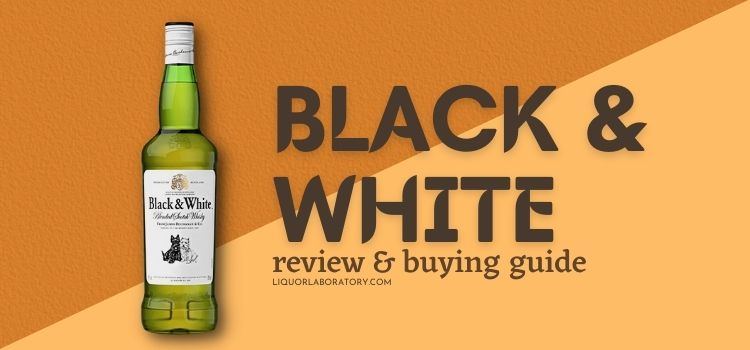
Black & White is a blended Scotch whisky created by James Buchanan and now owned by Diageo. It is bottled at 40% ABV (80 proof) in the US, it is famous for the black Scottish terrier and white West Highland terrier on its label, and Diageo positions it as “a scotch made for mixing and sharing.” It is sold mainly in export markets, including the United States, rather than in the United Kingdom.
This guide covers the brand’s history, how it is made and labeled, how it compares with other blended Scotch, and simple ways to drink it. Prices change by state and retailer, so we leave them off the page; check your local store or state liquor board listing.
History of Black & White
James Buchanan, a London based whisky merchant, launched his blend in 1879 under the name Buchanan’s Blend. The blend was also sold as House of Commons, a name taken from the British House of Commons. Its distinctive black and white label gave it a nickname that drinkers used so widely it eventually became the official brand name. Diageo’s own brand page dates the establishment of the Black & White brand to 1904.
The two terriers arrived in the 1890s. According to Diageo, Buchanan was inspired by a photograph of champion terriers he brought back from a dog show, and the pair appeared in advertising before they moved onto the label. The black dog is a Scottish terrier, or Scottie; the white dog is a West Highland white terrier, or Westie.
James Buchanan & Co. merged with John Dewar & Sons in 1915, and the business later passed through the Distillers Company and Guinness before becoming part of Diageo. The brand has described itself as among the most successful Scotch whiskies in markets such as France, Venezuela and Brazil.
How Black & White is made and labeled
Black & White is a blended Scotch, meaning it combines malt whisky with grain whisky. Diageo does not publish the recipe or a list of component distilleries. What is fixed is the legal framework:
- UK law. The Scotch Whisky Regulations 2009 require Scotch to be matured only in Scotland, in oak casks of no more than 700 litres, for at least three years, and bottled at a minimum of 40% ABV. Only water and plain caramel coloring may be added.
- US law. Under 27 CFR § 5.143, “Scotch whisky” is a distinctive product of Scotland, made in Scotland in compliance with UK law. A mixture of Scotch whiskies must be labeled “blended Scotch whisky” or “Scotch whisky, a blend.”
- Strength. US listings, including the Maine state liquor catalog, show Black & White at 80 proof (40% ABV), the minimum strength permitted for Scotch.
Because there is no age statement, every whisky in the bottle is at least three years old, though blends often contain older components. For a full explanation of how blends differ from single malts, read what blended whiskey is.
What to expect in the glass
Diageo does not publish detailed tasting notes for Black & White, and we do not invent them. The brand’s own positioning, “a scotch made for mixing and sharing,” tells you how it is meant to be used: as an everyday blend for highballs and simple mixed drinks rather than a sipping whisky to analyze neat. If you are new to the category, our guide to the best Scotch for beginners explains the main flavor families, from light and grassy to rich and smoky.
Black & White vs other blended Scotch
Black & White competes with other widely distributed blends. The most useful comparisons are by brand style and bottle strength rather than price:
- Johnnie Walker. The best known Scotch blend family, with a wide range of age statements. See our Johnnie Walker guide and our comparison of Johnnie Walker Black vs Double Black.
- Single malts. Glenlivet and Macallan are single malts, made at one distillery from malted barley only, which is a different category from a blend. Read Glenlivet vs Macallan for that side of the shelf.
- Irish whiskey. Irish blends are often compared with Scotch blends; our Scotch whisky vs Irish whiskey explainer covers the legal and stylistic differences.
For broader context on every major style, start with our whisky brand overview and the Whiskey Guide.
How to drink Black & White
Because the brand is built for mixing, simple serves work best:
- Scotch and soda. 45 ml (1.5 oz) Black & White over ice in a highball glass, topped with chilled soda water and a lemon twist.
- Scotch and ginger ale. Same build with ginger ale for a sweeter, spicier highball.
- Rob Roy. A Scotch Manhattan: blended Scotch stirred with sweet vermouth and a dash of bitters, strained and garnished with a cherry.
- On the rocks. A large cube softens the alcohol and opens the aroma.
A 750 ml bottle holds about 25.4 ounces, or roughly 17 pours of 1.5 ounces; see how many shots are in a 750 ml bottle. Each 1.5 ounce pour at 40% ABV is one US standard drink.
Vintage bottles
Older Black & White bottles, especially pre war and mid century releases with Buchanan branding, appear at whisky auctions. Values depend on fill level, seal condition, label condition and provenance, and they change constantly, so consult a reputable auction house rather than any fixed figure. Spirits do not age further once bottled, so an old bottle tastes like the blend of its era, not an older whisky.
FAQ
Who makes Black & White whisky?
Diageo owns and produces Black & White. The brand was created by James Buchanan, whose company later became part of Diageo through a series of mergers.
What proof is Black & White Scotch?
US listings show 80 proof, which is 40% ABV.
What are the dogs on the Black & White label?
A black Scottish terrier and a white West Highland white terrier, introduced by James Buchanan in the 1890s.
Is Black & White a single malt?
No. It is a blended Scotch whisky that combines malt and grain whiskies.
Is Black & White sold in the UK?
It is sold mainly in export markets. If you are in the US, check your state liquor board or local retailer for availability.
Sources
- The Scotch Whisky Regulations 2009, regulation 3, legislation.gov.uk.
- 27 CFR § 5.143, Whisky (Scotch whisky standard), Cornell Legal Information Institute.
- Diageo India, Black & White brand page (1904 establishment, terrier story, “a scotch made for mixing and sharing”).
- Maine Bureau of Alcoholic Beverages product listing, Black & White Scotch Whisky 1.75L, 80 proof.
- Black & White (whisky) entry, Wikipedia (1879 launch, House of Commons name, ownership history, markets).