Updated November 2026
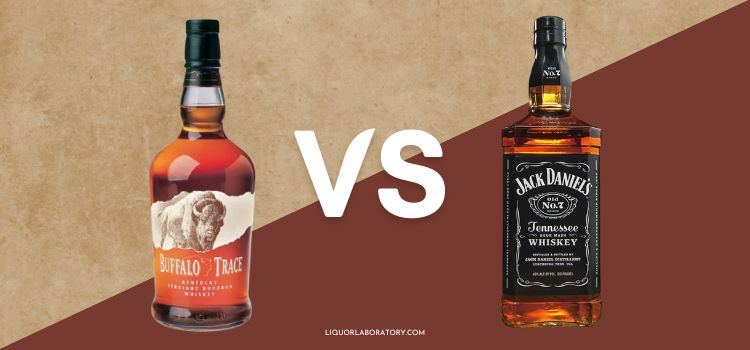
Buffalo Trace is a Kentucky straight bourbon bottled at 90 proof (45% ABV); Jack Daniel’s Old No. 7 is a Tennessee whiskey bottled at 80 proof (40% ABV). Both start from a corn-heavy mash and age in new charred oak, but Jack Daniel’s drips through ten feet of sugar maple charcoal before it goes into the barrel. The result: Buffalo Trace drinks richer and spicier, with brown sugar and toffee, while Jack Daniel’s is lighter, softer and more caramel and banana forward.
Buffalo Trace vs Jack Daniel’s at a Glance
| Buffalo Trace | Jack Daniel’s Old No. 7 | |
|---|---|---|
| Style | Kentucky straight bourbon whiskey | Tennessee whiskey |
| Proof / ABV | 90 proof / 45% | 80 proof / 40% |
| Distillery | Buffalo Trace Distillery, Frankfort, Kentucky (Sazerac) | Jack Daniel Distillery, Lynchburg, Tennessee (Brown-Forman) |
| Mash bill | Buffalo Trace Mash Bill #1 (percentages not published) | 80% corn, 12% malted barley, 8% rye |
| Charcoal filtering | No | Yes, sugar maple charcoal before aging |
| Age statement | None (so at least 4 years by federal rule) | None (so at least 4 years by federal rule) |
| Standard drinks per 1.5 oz | About 1.1 | 1.0 |
Proofs are from the North Carolina ABC price list and the brands’ own listings. Labels can vary by market and bottle size, so check the bottle in front of you.
Bourbon vs Tennessee Whiskey: The Legal Difference
Buffalo Trace is bourbon under federal rules. 27 CFR § 5.143 requires bourbon to be made in the United States from a mash of at least 51% corn, distilled at no more than 160 proof, entered into new charred oak containers at no more than 125 proof, and bottled at 80 proof or more. Because Buffalo Trace is labeled “straight,” it has been aged at least two years and has no added coloring or flavoring.
Jack Daniel’s is Tennessee whiskey, a term defined by state law. Tennessee Code § 57-2-106 says a product may be called Tennessee whiskey only if it is made in Tennessee from a mash of at least 51% corn, distilled to no more than 160 proof, aged in new charred oak barrels in Tennessee, filtered through maple charcoal prior to aging, placed in the barrel at no more than 125 proof, and bottled at no less than 80 proof. The statute took effect in 2013 and has a narrow exception to the charcoal rule for one distillery.
Look closely and the two definitions overlap almost entirely. The practical difference is the maple charcoal step, plus where the whiskey is made and aged. That is why people argue about whether Jack Daniel’s “is” bourbon. The simple answer: it is made much like a bourbon, but it is labeled, sold and legally protected as Tennessee whiskey.
Neither bottle carries an age statement. Under 27 CFR § 5.74(b), whiskey younger than four years must state its age on the label, so both are at least four years old. Difford’s Guide reports that Old No. 7 spends more than four years in barrel.
How Each One Is Made
Buffalo Trace
Buffalo Trace comes from the distillery of the same name in Frankfort, Kentucky, owned by Sazerac. The brand lists the recipe as its Mash Bill #1 and says the whiskey ages in new charred oak barrels “for many years” in century-old warehouses. The distillery takes its name from the old buffalo paths that early settlers followed west, one of which ran through the site. The exact grain percentages are not published, so be wary of any page that quotes them as fact.
Jack Daniel’s Old No. 7
Jack Daniel’s is made in Lynchburg, Moore County, Tennessee, at a distillery Brown-Forman dates to 1866. According to Difford’s Guide, the mash is 80% corn, 12% malted barley and 8% rye. The new spirit then drips by gravity through ten feet of packed sugar maple charcoal, the step the brand calls charcoal mellowing and many writers call the Lincoln County Process. Brown-Forman builds its own new charred white oak barrels.
Charcoal filtering strips out some of the heavier compounds in new spirit, which is one reason Jack Daniel’s tastes softer and lighter than many bourbons at a similar age.
How They Taste
Buffalo Trace’s own notes describe a deep amber whiskey with “a complex aroma of vanilla, mint and molasses,” a palate that is “pleasantly sweet” with “brown sugar and spice that give way to oak, toffee, dark fruit and anise,” and a finish that is “long and smooth with serious depth.”
Jack Daniel’s notes, as published on its retail listings, describe an orange-amber whiskey with an aroma of “caramel with mild hints of banana,” a “balanced caramel, vanilla and toasted oak, medium bodied” palate and a “creamy and clean” finish.
In plain terms, Buffalo Trace has more weight and spice, helped by its extra 10 proof. Jack Daniel’s is rounder and gentler, with a signature banana note that many drinkers recognize instantly.
Strength and Standard Drinks
The NIAAA defines a US standard drink as 14 grams of pure alcohol, which is about 0.6 fluid ounces. A 1.5 oz pour of Jack Daniel’s at 40% holds 0.6 oz of alcohol, exactly one standard drink. The same pour of Buffalo Trace at 45% holds 0.675 oz, about 1.1 standard drinks. Across a full 750 mL bottle, that works out to roughly 17 standard drinks for Jack Daniel’s and about 19 for Buffalo Trace. For more on bottle strength, see what proof is Jack Daniel’s and our guide to whiskey drinks and how strong they are. Never drink and drive.
Which One Should You Buy?
- For an Old Fashioned or Manhattan: Buffalo Trace. The higher proof and brown sugar and spice notes hold up to bitters, sugar and vermouth.
- For whiskey and Coke or other highballs: Jack Daniel’s. Its soft caramel and banana profile is the classic match for cola and ginger ale. See the best whiskey for mixed drinks for more options.
- For sipping neat: Buffalo Trace, if you like richness and a longer finish. Jack Daniel’s if you want something lighter.
If you are weighing other pairings, read Jameson vs Jack Daniel’s and Wild Turkey 101 vs Buffalo Trace, or start with the profiles of Buffalo Trace and Jack Daniel’s. The bourbon guide and whiskey guide cover the wider category.
Frequently Asked Questions
Is Jack Daniel’s a bourbon?
Jack Daniel’s is sold as Tennessee whiskey. It is made much like bourbon, from a corn-heavy mash aged in new charred oak, but it is filtered through sugar maple charcoal before aging, and Tennessee law (Tenn. Code § 57-2-106) defines it as its own style.
Is Buffalo Trace stronger than Jack Daniel’s?
Yes. Buffalo Trace is 90 proof (45% ABV) and Jack Daniel’s Old No. 7 is 80 proof (40% ABV), so a pour of Buffalo Trace carries about 12% more alcohol.
Which is smoother, Buffalo Trace or Jack Daniel’s?
Jack Daniel’s is lighter and softer because of its lower proof and charcoal mellowing. Buffalo Trace is richer, with more spice and a longer finish. Smoothness is personal, so try both neat with a splash of water.
How old are Buffalo Trace and Jack Daniel’s?
Neither carries an age statement. Federal rules in 27 CFR § 5.74 require an age statement for whiskey under four years old, so both are at least four years old.
Who makes Buffalo Trace and Jack Daniel’s?
Buffalo Trace is made by Buffalo Trace Distillery in Frankfort, Kentucky, owned by Sazerac. Jack Daniel’s is made in Lynchburg, Tennessee, by Brown-Forman.
Sources
- Buffalo Trace Distillery, Buffalo Trace Bourbon product page: 90 proof, Mash Bill #1, tasting notes, name origin.
- Difford’s Guide, Jack Daniel’s crafting: 80% corn, 12% malted barley, 8% rye; ten feet of sugar maple charcoal; aging; Lynchburg, 1866; Brown-Forman.
- ReserveBar, Jack Daniel’s Old No. 7 listing: 40% ABV and tasting notes.
- North Carolina ABC Commission price list: Buffalo Trace 90 proof, Jack Daniel’s 80 proof.
- 27 CFR § 5.143, bourbon whisky standard of identity; 27 CFR § 5.74, statements of age (Cornell LII).
- Tennessee Code Annotated § 57-2-106, Tennessee whiskey requirements (Justia).
- NIAAA, What Is a Standard Drink?: 14 grams of pure alcohol.