Updated November 2026
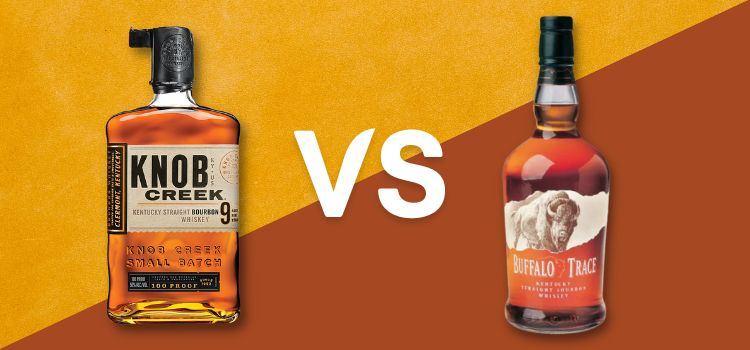
Knob Creek and Buffalo Trace are both Kentucky straight bourbons, but they aim at different drinkers. Knob Creek 9 Year is bottled at 100 proof (50% ABV) and carries a nine year age statement, so it drinks bold, nutty and oaky with plenty of warmth. Buffalo Trace is 90 proof (45% ABV) with no age statement, and it drinks sweeter and softer, with vanilla, brown sugar, toffee and mint. Pick Knob Creek if you want a bigger bourbon that stands up to ice and cocktails; pick Buffalo Trace for an easy, sweet sipper that is gentle neat.
Below we compare how each is made, what the label guarantees, how the producers describe the taste, how strong a pour is and which one fits the way you drink. New to the category? Start with our Bourbon Guide.
Knob Creek vs Buffalo Trace at a glance
| Knob Creek 9 Year | Buffalo Trace | |
|---|---|---|
| Style | Kentucky straight bourbon | Kentucky straight bourbon |
| Proof / ABV | 100 proof / 50% | 90 proof / 45% |
| Age statement | 9 years | None (at least 4 years) |
| Recipe | Same general formula as Jim Beam (percentages not published) | Mash Bill #1 (percentages not published) |
| Distillery | Jim Beam, Clermont, Kentucky | Buffalo Trace Distillery, Frankfort, Kentucky |
| Owner | Suntory Global Spirits | Sazerac Company |
| Introduced | 1992 | 1999 |
| Standard drinks per 1.5 oz | 1.25 | About 1.1 |
| Best use | On a large cube, Old Fashioned, Manhattan | Neat, Whiskey Sour, highballs |
What both labels guarantee
Both bottles meet the same federal standard. Under 27 CFR § 5.143, bourbon must be made in the United States from a fermented mash of at least 51% corn, distilled at no more than 160 proof, entered into new charred oak containers at no more than 125 proof and bottled at 80 proof or higher, with no added coloring or flavoring. A straight bourbon has spent at least two years in those new charred barrels.
Age labeling is where they differ. Under 27 CFR § 5.74, a straight whisky aged less than four years must state its age, and when an age is stated it refers to the youngest whisky in the bottle. Knob Creek’s “9 Years” therefore means every drop has spent at least nine years in oak. Buffalo Trace has no age statement, which tells you only that it is at least four years old.
Knob Creek: big, nutty and 100 proof
Knob Creek was introduced in 1992 by Jim Beam’s Booker Noe as part of the original Small Batch Bourbon Collection, alongside Booker’s, Baker’s and Basil Hayden. It is distilled at the Jim Beam distillery in Clermont, Kentucky, and shares the same general formula as Jim Beam, but it is aged longer and bottled stronger. The brand is owned by Suntory Global Spirits.
Knob Creek dropped its nine year age statement around 2016 because of tight stocks of mature whiskey. Beam announced in 2019 that it would return, and the 9 Year label came back in 2020. The brand describes the color as copper to medium amber, the aroma as toasted nuts, grain, oak, vanilla and caramel, the taste as rich, sweet and full bodied, woody with dried fruit, and the finish as long and glowing. For the rest of the range, including the 12 Year and single barrel bottlings, see our guide to the best Knob Creek bourbons and our list of the best 12 year old bourbons.
Buffalo Trace: soft, sweet and easy
Buffalo Trace is the namesake bourbon of the Buffalo Trace Distillery in Frankfort, which the Sazerac Company owns. The distillery lists it at 90 proof and made from its Mash Bill #1, and it does not publish the grain percentages. It describes a complex aroma of vanilla, mint and molasses, a pleasantly sweet taste of brown sugar and spice that gives way to oak, toffee, dark fruit and anise, and a long, smooth finish.
Demand is high, so Buffalo Trace can be hard to find in some areas. For more head to head comparisons, see Buffalo Trace vs Woodford Reserve, Buffalo Trace vs Four Roses and Basil Hayden vs Buffalo Trace.
How they taste side by side
- Sweetness: Buffalo Trace is the sweeter of the two, with brown sugar, toffee and vanilla up front. Knob Creek is sweet too, but the nine years in oak push it toward caramel, toasted nuts and wood.
- Oak: Knob Creek is noticeably oakier and drier, as you would expect from the longer aging.
- Heat: at 100 proof, Knob Creek is hotter neat. A splash of water or a large ice cube opens it up. Buffalo Trace is gentle enough to sip neat for most people.
- Finish: Knob Creek’s finish is longer and warmer; Buffalo Trace ends smooth, with a little mint and anise.
Strength and standard drinks
A US standard drink contains 14 grams of alcohol, the amount in 1.5 oz of 40% ABV spirit (0.6 oz of pure alcohol). For a 1.5 oz pour:
- Knob Creek 9 Year (50%): 1.5 x 0.50 = 0.75 oz of alcohol, or 1.25 standard drinks.
- Buffalo Trace (45%): 1.5 x 0.45 = about 0.68 oz of alcohol, or about 1.1 standard drinks.
A 750 ml bottle (about 25.4 oz) holds about 21 standard drinks of Knob Creek and about 19 of Buffalo Trace. Our guide to how much whiskey it takes to feel the effects explains more. Pace yourself and never drink and drive.
Which works better in cocktails?
- Old Fashioned: Knob Creek’s 100 proof keeps the drink bold as the ice melts. The IBA builds an Old Fashioned with 45 ml bourbon or rye, a sugar cube, a few dashes of Angostura bitters and a splash of water. See our best bourbon for an Old Fashioned.
- Manhattan: Knob Creek again, since its oak and strength stand up to sweet vermouth. The IBA spec is 50 ml rye, 20 ml sweet vermouth and a dash of Angostura bitters.
- Whiskey Sour: Buffalo Trace’s soft sweetness keeps a sour bright. The IBA uses 45 ml bourbon, 25 ml fresh lemon juice and 20 ml sugar syrup.
- Highballs and holiday drinks: either works with ginger ale or hot cider; Buffalo Trace is the gentler choice for a Hot Toddy.
Which one should you buy?
- You want a bold, high proof bourbon: Knob Creek 9 Year.
- You want a guaranteed age on the label: Knob Creek 9 Year.
- You want something sweet and easy to sip neat: Buffalo Trace.
- You mostly make stirred cocktails: Knob Creek.
- You are new to bourbon: Buffalo Trace, then move up to Knob Creek.
Want something stronger still with a legal guarantee behind it? Read our guide to the best bottled in bond bourbon, or compare Knob Creek with a lower proof stablemate in Basil Hayden vs Knob Creek.
FAQ
Is Knob Creek better than Buffalo Trace?
Neither is better for everyone. Knob Creek is older, stronger and oakier; Buffalo Trace is sweeter and softer. Choose by taste and how you drink.
Which is stronger, Knob Creek or Buffalo Trace?
Knob Creek 9 Year, at 100 proof (50% ABV) versus 90 proof (45% ABV) for Buffalo Trace.
How old is Knob Creek?
The core Knob Creek carries a 9 year age statement, which under 27 CFR § 5.74 refers to the youngest whiskey in the bottle.
How old is Buffalo Trace?
It has no age statement, so as a straight bourbon it is at least four years old. The distillery does not publish an exact age.
Who makes Knob Creek and Buffalo Trace?
Knob Creek is made at the Jim Beam distillery in Clermont, Kentucky, for Suntory Global Spirits. Buffalo Trace is made by the Sazerac Company in Frankfort, Kentucky.
Sources
- Knob Creek, press release on the return of Knob Creek 9 Year Old (100 proof, introduced in 1992 by Booker Noe, original small batch bourbon collection, tasting notes).
- The Whiskey Wash, “Knob Creek Bourbon To Get Its 9 Year Age Statement Back,” June 13, 2019; Wikipedia, “Knob Creek (bourbon)” (Clermont distillery, Suntory Global Spirits, age statement history).
- Buffalo Trace Distillery, Buffalo Trace Kentucky Straight Bourbon page (90 proof, Mash Bill #1, tasting notes) and history page (Sazerac Company).
- 27 CFR § 5.143 (bourbon and straight whisky) and 27 CFR § 5.74 (age statements), Cornell Legal Information Institute.
- International Bartenders Association, Old Fashioned, Manhattan and Whiskey Sour specifications.
- NIAAA, What Is a Standard Drink?